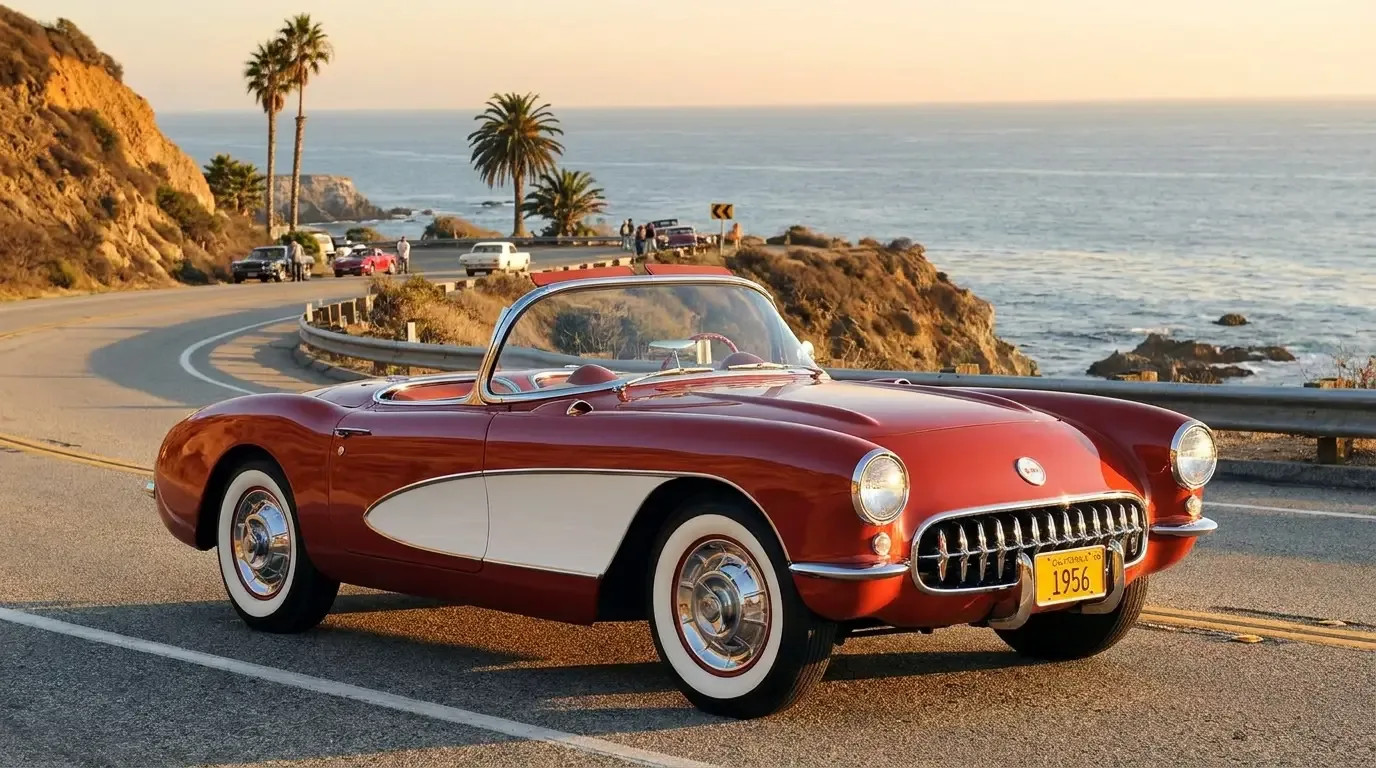
The 1957 Corvette is remembered for a lot of things: the first year the small-block could be ordered with a four-speed manual, the first year dual-quad carburetors were available, and a chassis that finally felt sorted after the early C1 stumbles. But among serious collectors and NCRS judges, the conversation almost always comes back to one option: the Rochester fuel injection unit, known then and now as the "fuelie." To understand why that option matters, and why finding a genuine one is harder than the asking prices suggest, you need to understand what Chevrolet was actually trying to do in 1957, and what it cost them to do it.
For context on how the C1 evolved to this point, more on c1 corvette covers the full arc from the original 1953 six-cylinder to the transformed 1956 model that made the sports car credible. The fuel injection option is the next chapter in that story.
Why Rochester fuel injection, and why in 1957
By 1956, the Corvette had a real V8 and a real following. But Chevrolet was watching what happened at the race track and, more specifically, watching the fuel injection experiments coming out of Mercedes-Benz and the European racing establishment. General Motors had its own fuel injection development underway, led by engineer John Dolza, and the 1957 Corvette was where that work landed in production form.
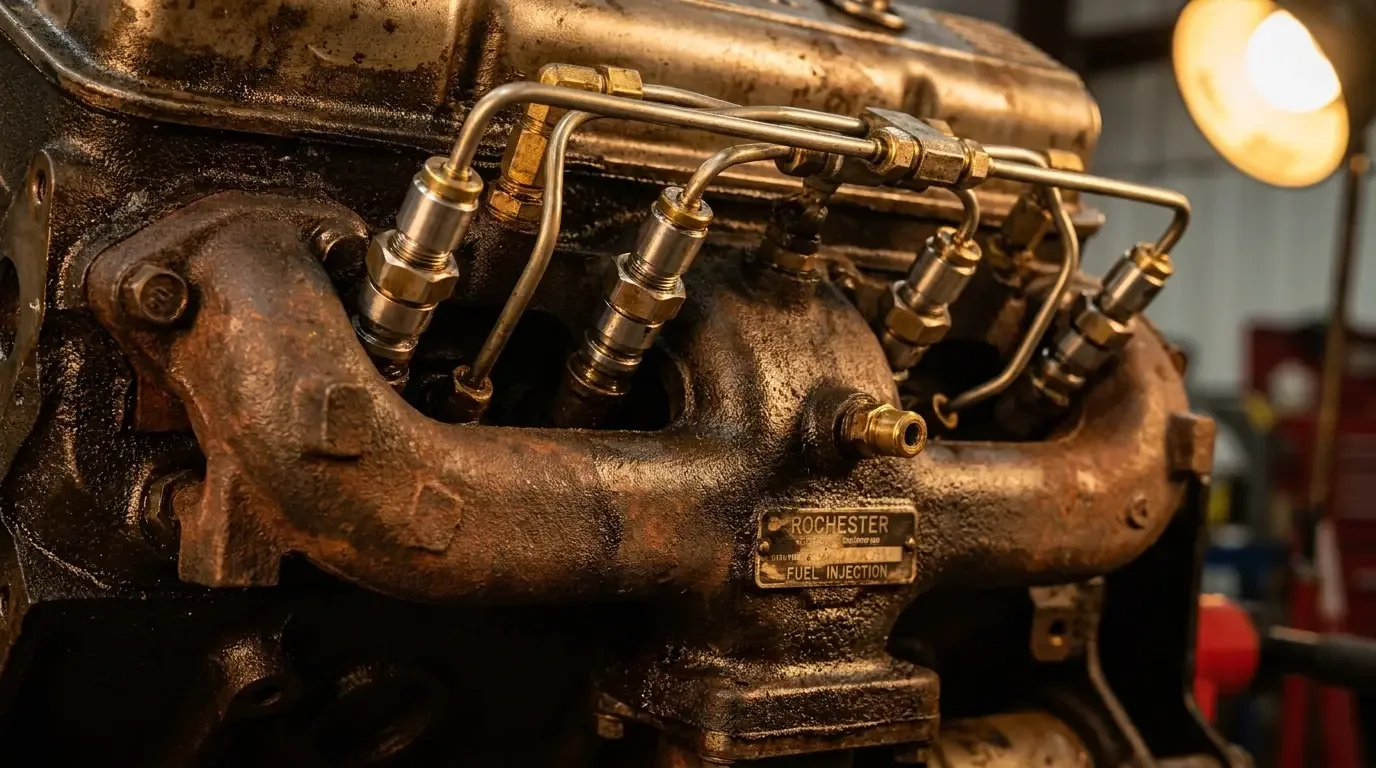
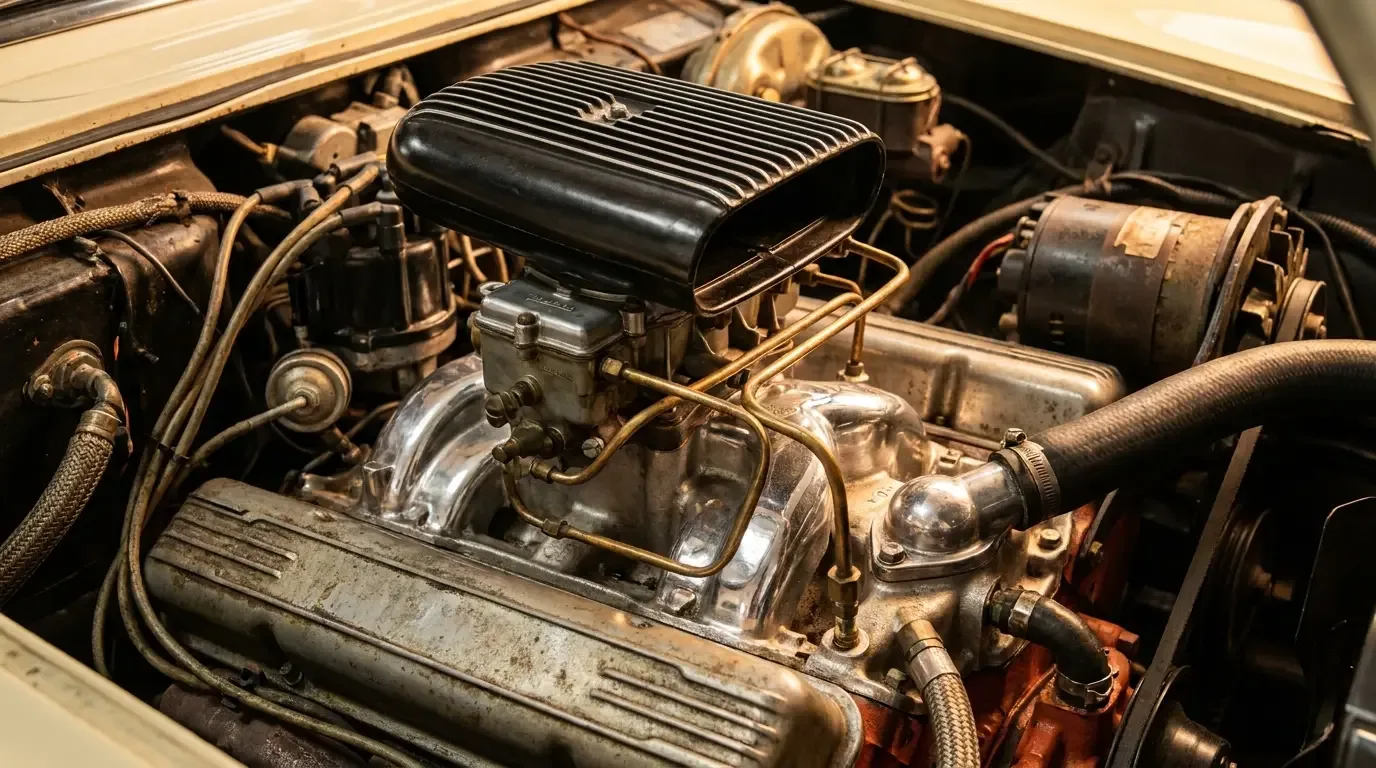
The Rochester mechanical fuel injection system used a continuous-flow design rather than pulsed injection. Fuel was metered through a single distributor-style unit mounted in the valley of the engine, drawing on engine vacuum and throttle position to govern fuel delivery. It was not a sophisticated system by later standards. It ran lean under cold conditions, it required careful tuning to idle smoothly, and it was sensitive to dirt in the fuel lines. But it had one property that mattered most in 1957: at wide-open throttle, at high rpm, it delivered fuel more consistently than a carburetor could.
On the 283 cubic inch small-block, Chevrolet rated the fuel-injected version at 250 horsepower in one state of tune (RPO 579A/579C) and 283 horsepower in the solid-lifter, high-compression version (RPO 579B/579E). The 283-horsepower figure, one horsepower per cubic inch, was the marketing story Chevrolet wanted to tell, and it is the milestone period press coverage fixated on. Whether every production engine consistently made exactly that number on a dyno is a question worth holding loosely. the next chapter goes deeper into how that specific rating was documented and what the engine actually produced on a dyno.
What the fuelie option actually included
| RPO | Description | Rated HP | Compression |
|---|---|---|---|
| RPO 579A / 579C | 283 V8 with fuel injection, hydraulic lifters | 250 hp | 9.5:1 |
| RPO 579B / 579E | 283 V8 with fuel injection, solid lifters, Duntov cam | 283 hp | 10.5:1 |
Note that RPO 469 was not a fuel injection code at all: it designated the dual four-barrel carbureted 283, rated 245 hp and 270 hp depending on tune, and is a separate (and separately collectible) 1957 option. The fuel injection codes were 579A and 579C for the 250-hp, 9.5:1-compression combination, and 579B and 579E for the 283-hp, 10.5:1-compression combination with solid lifters and the Duntov cam. RPO 579E was a late-production "Cold Air" variant of the hot setup. Base 579-code fuel injection added $484.20 over a carbureted engine; the 579E Cold Air version carried a steeper $726.30 premium. That was serious money against a Corvette base price of $3,176.32 for 1957.
Production numbers for the fuelie 1957 Corvette are well documented in outline, though specific splits by RPO subcode vary slightly between sources. Total 1957 Corvette production came in at 6,339 units. Of those, roughly 1,040 were built with fuel injection across both tune states, a small fraction of total production, and the 283-hp, 10.5:1-compression version was the rarer and more sought-after of the two. NCRS data and tank sticker research have refined these counts over the years, but treat any specific fuelie production number broken out by exact sub-RPO as approximate until it's sourced to a primary document for that individual car.
The real problems with owning a fuelie
Genuine fuelie Corvettes are hard to find for a reason that has nothing to do with production numbers. The Rochester injection system was notoriously difficult to keep in tune, and by the time many of these cars hit their second or third owner, the fuel injection had been swapped out for a carburetor. The swap took an afternoon and made the car easier to live with. The injection unit went into a box, and the box often did not follow the car.
What this means for the buyer today: a car presented as a fuelie needs documentation, not just the presence of an injection unit. The injection unit should carry the correct casting numbers for 1957, and those numbers need to match what the factory installed on that specific engine configuration. Rebadged units exist. Transplanted units from later years exist. The tank sticker is the most reliable primary source for confirming that the car left the factory with fuel injection, and even then, confirming the specific tune state requires matching the engine tag and carburetor pad number, which does not apply here since there is no carb, but the equivalent casting and date code research applies fully.
"The injection unit can be rebuilt, sourced, even fabricated in some cases. What cannot be recreated is the tank sticker. If the car left the factory with fuel injection, the sticker says so. If the sticker is gone or misread, you are doing a lot of inferencing on a car that is going to cost you real money."
— Tom Ramirez
Beyond the injection documentation question, 1957 Corvettes share the common C1 ownership issues: fiberglass bodies that absorbed moisture and delaminated at the inner panels, frame rust at the rear kick-up, and early production cars with body fit that never fully sorted itself. The fuelie cars are not structurally different from the carbureted cars; they carry the same vulnerabilities. Any inspection should start with the frame and body before it gets anywhere near the engine.
Market reality: what a real one costs and why fakes exist
The price gap between a documented fuelie 1957 Corvette and a carbureted car of equivalent condition is large enough to create strong financial incentive for fraud. Driver-quality carbureted 1957 Corvettes have generally traded in the $60,000 to $90,000 range depending on color, transmission, and documentation. Comparable documented fuelie cars with the 283-hp option have reached well above $100,000 at auction for solid drivers; RM Sotheby's and Barrett-Jackson have both sold fuel-injected 1957 Corvettes in the $100,000 to $140,000 range in recent years, with concours-correct and historically significant examples pushing dramatically higher. Numbers at the top of the market should be checked against recent Mecum, Barrett-Jackson, and RM Sotheby's results before any offer is made.
That gap is why the tank sticker matters so much. A reproduction injection unit and a plausible story can be assembled for a few thousand dollars. The research to unwind a fake can take months. If you are buying without engaging someone who knows 1957 factory documentation, you are accepting risk that the price does not justify.
The full story of how the Corvette became a serious sports car through the mid-1950s is covered in the full story, which provides the competitive and design context that makes the 1957 fuel injection option make sense as a factory decision.
Where to find 1957 Corvette fuelies now
The supply of documented fuelie 1957 Corvettes reaching the market in any given year is small. NCRS regional meets and Bloomington Gold produce a handful of known-history cars. Major auction houses move perhaps a dozen examples annually across all conditions. Private sales within the Corvette community account for a meaningful share, and those transactions often happen before the car is ever advertised publicly.
Online listings skew toward the aspirational side. Many cars described as "fuelie" are carbureted cars with injection units added, or cars where the documentation is absent and the seller is being optimistic rather than fraudulent. The filtering tools at 1957 Corvettes for sale let you search current inventory with year and model parameters, which is a useful starting point for understanding what is currently asking what price before you make contact with any seller.
The 1957 fuel injection option represents a specific moment in American performance engineering: a genuine technical leap that was too complicated for most buyers to maintain and too significant for serious collectors to ignore. The cars that have survived with correct documentation and intact injection systems are rare enough that prices reflect it. The cars that have been modified or misrepresented are common enough that skepticism is warranted. Know the difference before you write the check.
Sources and notes
- CorvSport: 1957 Corvette Pricing, Factory Options & Colors: confirmed RPO 469 (dual-quad carb, 245/270 hp), RPO 579A/579C (fuel injection, 250 hp, 9.5:1), RPO 579B/579E (fuel injection, 283 hp, 10.5:1), fuel injection pricing at $484.20 and $726.30, and base convertible price of $3,176.32
- CorvSport: 1957 Corvette Production Numbers: confirmed total 1957 production of 6,339 units and roughly 1,040 fuel-injected engines built
- Wikipedia: Rochester Ramjet: confirmed the mechanical, continuous-flow design and development credit to John Dolza with Zora Arkus-Duntov on the Corvette application
- MotorCities: One Horsepower Per Cubic Inch, 1957 Chevy Corvette: confirmed the 283-hp/283-cubic-inch marketing milestone and period press context
- CarBuzz: 1957 Pontiac Star Chief Bonneville: confirmed Rochester fuel injection was also standard on the 1957 Pontiac Bonneville that same model year
- RM Sotheby's: 1957 Chevrolet Corvette 'Fuel-Injected' auction listing: reference point for current fuel-injected 1957 Corvette auction pricing