
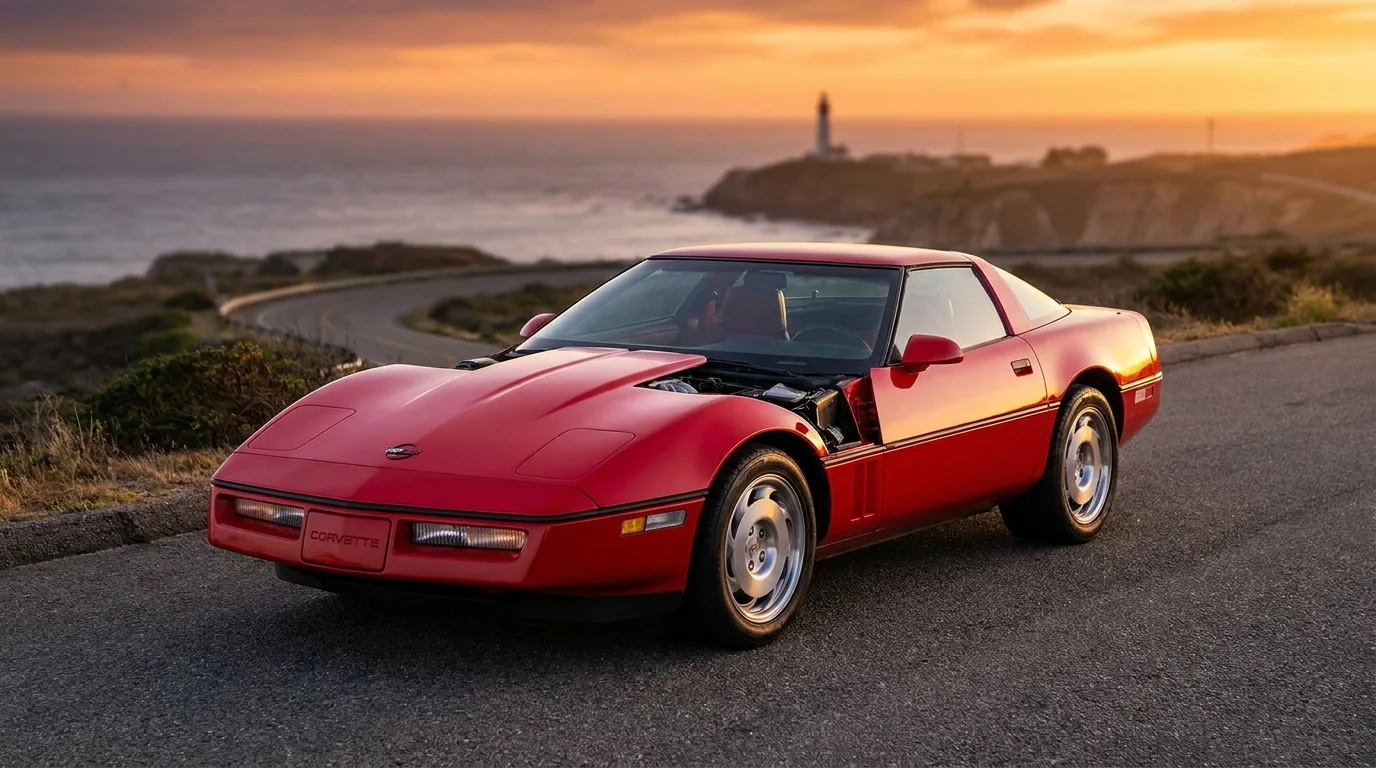
Chevrolet called it the most extensively redesigned Corvette since 1963. That claim is worth examining, because the company had a habit of making such statements about its sports car regardless of what actually changed. In 1984, though, the claim held up. The C4 was not an update of the C3. It was a new car built around a new platform, with a new interior, a new suspension geometry, and a new set of intentions about what the Corvette was supposed to be.
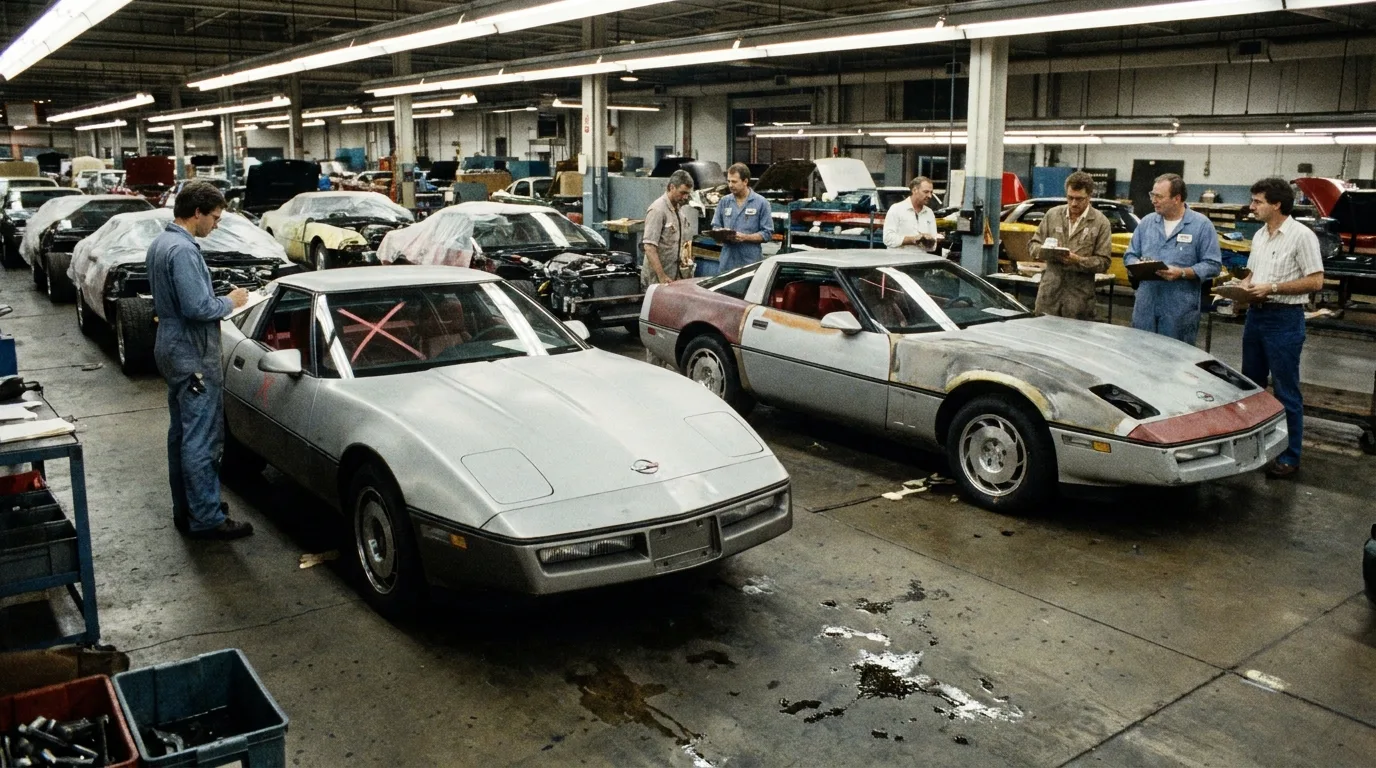
The debut came a year late by some reckonings. If you've ever wondered why there was no 1983 model year on the dealer lots, read the related story, the short version is that quality issues discovered during pre-production led GM to hold the car and sell it as an early-introduction 1984 model instead. That decision cost the factory an entire model year of sales, but it also meant the C4 that finally reached customers was cleaner than the cars that had failed inspection. For the full arc, see America’s sports car story.
To understand America's sports car story, you have to understand what the C4 was replacing. The C3 had run from 1968 through 1982, a span of fifteen years that included the emissions-and-compression-ratio collapse of the mid-1970s. By 1982, the base engine was a 200-hp Cross-Fire Injection 350 small-block that produced numbers a 1969 owner would have found embarrassing. The C4 was designed to reverse that trend and bring the Corvette back to the performance class it had occupied before the regulatory decade gutted American performance cars.
What changed with the platform
The C4 rode on a 96.2-inch wheelbase, slightly shorter than the outgoing C3's 98-inch unit, but the overall dimensions were reconfigured to improve interior space and reduce frontal area. The body was designed with a drag coefficient around 0.34, which was a serious number for a production car in 1984. The fiberglass body panels were carried over as a manufacturing choice but redesigned entirely in shape.
Underneath, the frame was a new steel backbone unit replacing the C3's ladder-type setup. The suspension went to a unilateral fiberglass mono-leaf spring at both ends, a GM engineering decision that shed weight compared to steel multi-leaf setups while retaining appropriate spring rates. Front suspension geometry was new. The rear used a five-link independent setup. Four-wheel disc brakes with aluminum calipers sourced from Girlock of Australia were standard, which was not something you could say about many American cars in 1984.
The steering was rack-and-pinion, another change from the C3's recirculating-ball setup. Steering feel on early C4s has been criticized in period road tests and by later owners, and that criticism is not entirely wrong, but it represented a different calibration philosophy rather than a simple failure.
The engine and what it actually made
The 1984 Corvette used the L83 350 small-block with Cross-Fire Injection, a twin-throttle-body fuel injection setup that GM had introduced on the 1982 Corvette. Power figures were rated at 205 hp and 290 lb-ft of torque. That was an improvement over the late C3 numbers but not the dramatic leap the press releases suggested. The Cross-Fire system was not held in high regard. It looked impressive with its two throttle bodies sitting on top of the engine, but the fuel delivery mapping was a product of early computer calibration work and it showed.
The transmission situation was more interesting. A conventional four-speed manual was never offered on the 1984 Corvette at all. The only manual available was the Doug Nash 4+3 overdrive unit, and even that did not reach regular production until January 1984, months after the car went on sale; the four-speed automatic was the transmission most early cars left the factory with. The 4+3 paired a four-speed manual with a computer-controlled overdrive unit engaged on the top three gears, intended to satisfy fuel economy requirements without forcing buyers into a pure automatic. It worked better in theory than in practice. The electronics that governed the overdrive engagement were responsible for a share of early warranty claims.
| Spec | 1984 Corvette C4 |
|---|---|
| Engine | L83 350 cu in (5.7L) V8, Cross-Fire Injection |
| Horsepower | 205 hp @ 4,200 rpm, 290 lb-ft @ 2,800 rpm |
| Transmission | 4+3 Doug Nash overdrive manual (from Jan. 1984) / THM700R4 automatic |
| Wheelbase | 96.2 in |
| Curb weight | approx. 3,100-3,200 lb (varies by source and options) |
| 0-60 mph | approx. 6.6-7.0 sec (period road tests varied) |
| Base price (1984) | $21,800 |
| Production (1984 MY) | 51,547 units |
The interior and the digital instruments
The C4 interior was as significant a departure as the platform. The dashboard used a fully electronic instrument cluster with digital readouts and a graphic display bar for the tachometer. Chevrolet was following the early-1980s assumption that buyers wanted digital instrumentation, an assumption that would prove incorrect within a few years. By the late C4 era, analog gauges had returned as an option and then as standard equipment. The 1984 cluster is a period piece now, but at the time it was genuinely innovative for a production sports car.
Cabin width increased noticeably over the C3, partly because the new backbone platform allowed more shoulder room without the intrusion of the C3's wide transmission tunnel. Visibility was different: the rear hatch gave a good rearward sightline but the flying buttress C-pillars of the C3 were gone, replaced by a cleaner greenhouse. The removable roof panel carried over as a standard feature.
"The 1984 instruments get a lot of grief, and some of it is deserved, but what people miss is how deliberate the whole interior was. This wasn't a quick restyle. GM's interior team built something that was genuinely different from anything else on the road in 1984. Whether the execution matched the ambition is a separate conversation."
— Tom Ramirez
Where the 1984 fits in the C4 story
The 1984 is the foundational year of the C4 generation, which ran through 1996. The generation that followed it includes some of the most capable Corvettes GM ever built, including the ZR-1 introduced for 1990 and the LT4-equipped cars of the final model years. Understanding the 1984 as the platform on which all of those cars were developed matters for anyone studying how the Corvette recovered its performance reputation across that decade. For a deeper look at how the generation developed, the C4 Corvette story covers the full arc from debut through the final year.
From a collector standpoint, the 1984 occupies specific territory. It is the first-year car of a generation that buyers often approach with first-year skepticism. The Cross-Fire Injection system, the 4+3 transmission, and the early electronics have given the 1984 a reputation for reliability issues that subsequent C4 years improved upon. That reputation is partially earned. The Cross-Fire cars did have fuel system issues that later L98 Tuned Port Injection cars from 1985 onward addressed. But the 1984 also represents the platform in its cleanest form before the emissions and power figures were optimized upward.
Current market pricing for honest driver-quality 1984 Corvettes runs roughly in the $10,000-$20,000 range, with well-documented, low-mileage original cars pushing higher; Hagerty rates the 1984 among the more affordable C4 model years to buy into. The 1984 does not command the premium of a first-model-year C1 or C2, but it is not without its collector constituency. If you want to browse current inventory, 1984 Corvettes for sale will show you what's available and what the market is actually doing right now.
The C4's debut in 1984 was not without its problems, and the factory knew it. The improvements that came in 1985 with the L98 engine addressed the most significant powertrain complaints directly. But the 1984 established what the Corvette would be for more than a decade: a platform with real engineering ambition, built by a company that had decided the sports car's slide through the 1970s was over.
Sources and notes
- Corvsport: 1984 Corvette Performance & Specifications, confirmed L83 output of 205 hp at 4,200-4,300 rpm and 290 lb-ft, 96.2-in wheelbase, and 4+3/automatic transmission options
- Wikipedia: Chevrolet Corvette (C4), confirmed $21,800 base price, 51,547-unit 1984 production total, and that the Doug Nash 4+3 manual did not reach regular production until January 1984
- Hagerty Valuation Tools: 1984-1996 Chevrolet Corvette market data, used to soften and check current driver-quality market pricing for 1984 cars
- Jalopnik: The Chevrolet Corvette C4's 'Doug Nash 4+3' Manual Transmission Is Mechanical Wizardry, confirmed 4+3 overdrive engagement on the top three gears and its early reliability reputation
- Hagerty Media: Crush Them All, confirmed the 1983 Corvette's quality-driven production hold and the surviving prototype now at the National Corvette Museum
- Vette Vues Magazine: Exploring the 1984 Corvette Specifications, cross-checked Girlock-sourced four-wheel disc brakes and other factory option data