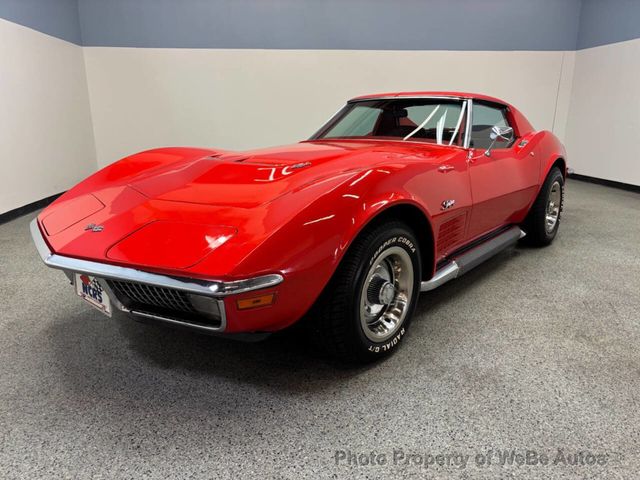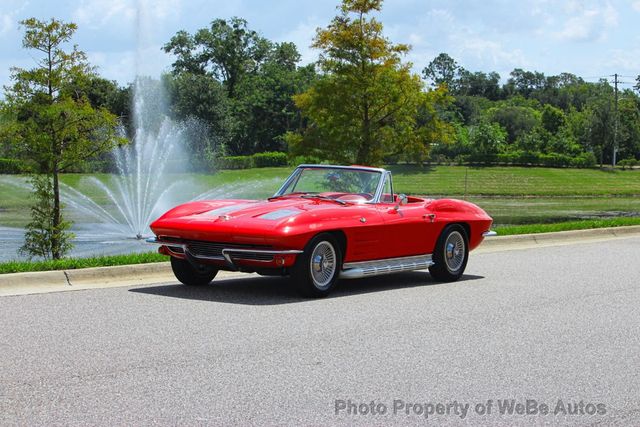
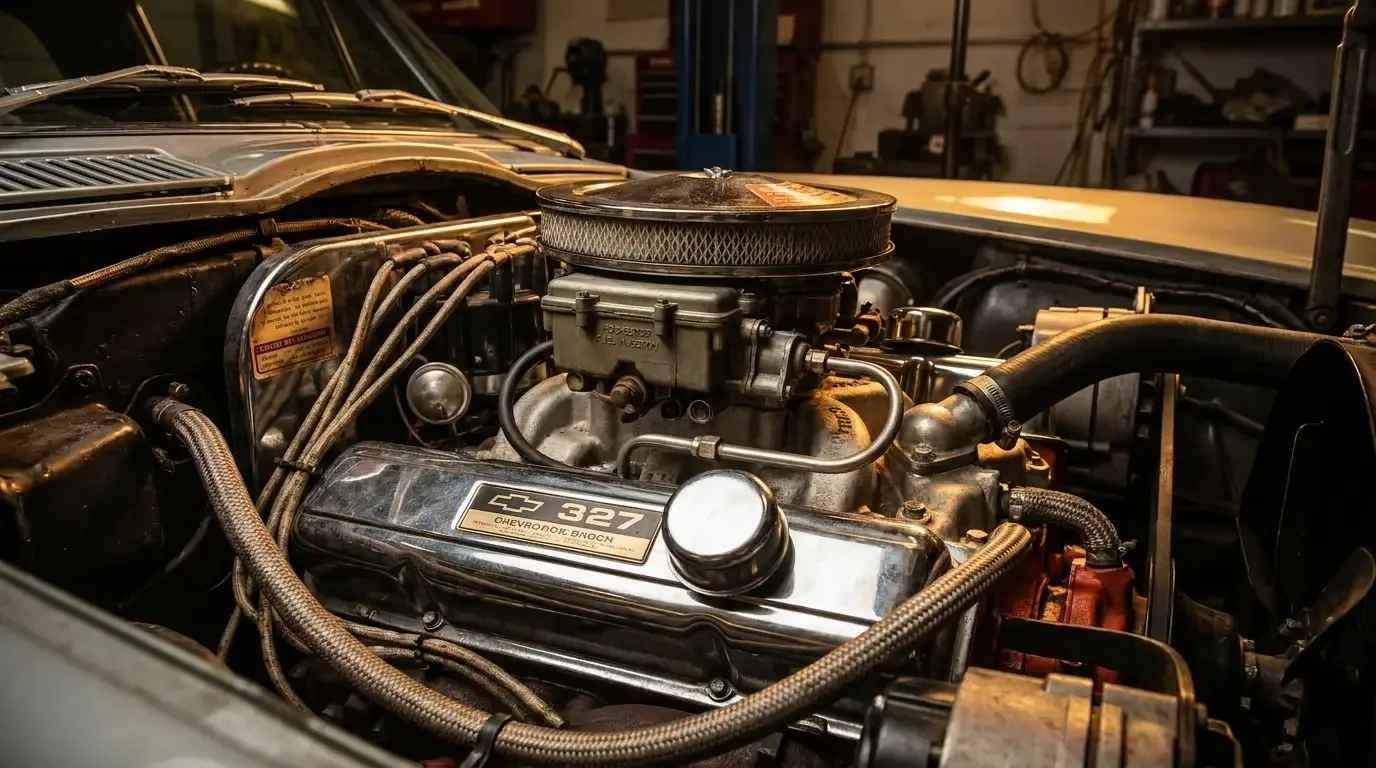
The C2 Corvette's engine story has always had two sides: the big-block cars that everybody remembers, and the small-block configurations that actually defined what the Sting Ray could do when it launched. Among those, two options stand out as the most historically interesting, the 327 with triple two-barrel carburetion, and the fuel-injected 327 that Chevrolet called the Fuelie. Neither is simple to document, and the 1963-1965 window when both appeared in the same chassis is short enough that most buyers today have only a vague picture of what was actually available. The C2 Corvette Sting Ray story is broader than any single engine option, but the tri-power and fuelie variants are where the factory documentation gets genuinely complicated.
What follows is what the records actually show, with honest flags where the numbers are disputed or where I'd want a second opinion before writing a check. For the full arc, see the whole story.
The 327 small-block in the C2: context first
When the Sting Ray body arrived for 1963, Corvette still ran the 327 cubic inch small-block as its sole displacement option. The 250 hp base engine used a single four-barrel carburetor and was the bread-and-butter powerplant. Above it sat three performance versions: a 300 hp, a 340 hp with solid lifters, and a 360 hp fuel-injected unit, all figures specific to the 1963 model year, since the 340 hp and 360 hp ratings both climbed for 1964. The tri-power option, meaning three two-barrel carburetors on a common intake manifold, was a separate and less commonly understood configuration. A reader who has been through the whole story of the Corvette's development will recognize that Chevrolet was still sorting out which performance delivery systems made sense for the car during this period.
The 327 displacement ran through the 1965 model year in the Corvette, after which the 427 big-block arrived as an option. So the window for C2 small-block study runs from 1963 through 1965, with the fuel-injection system phased out after 1965 and the RPO options shifting across those three years.
| RPO Code | Configuration | Rated Power | C2 Years Available |
|---|---|---|---|
| L75 | 327 / 300 hp, single 4-bbl | 300 hp | 1963-1965 |
| L76 | 327 / solid lifters, single 4-bbl (340 hp for 1963, 365 hp for 1964-1965 with revised cam and heads) | 340-365 hp | 1963-1965 |
| L84 | 327 / Rochester fuel injection (360 hp for 1963, 375 hp for 1964-1965) | 360-375 hp | 1963-1965 |
| Tri-Power | 327 with 3x 2-bbl carburetors | Not applicable, not a factory Corvette RPO | Not a factory Corvette option |
What "Tri-Power" actually means for a C2 Corvette
The confusion comes from terminology that bleeds across divisions. Pontiac's Tri-Power, offered on the GTO and other performance models from the early 1960s, used three two-barrel Rochester carburetors on a special intake manifold. The setup was factory-documented, dealer-installed as an RPO, and shows up on build sheets. Chevrolet used three-deuce configurations on the 409 engine in full-size cars during the same period, but that engine never appeared in a Corvette.
For the C2 Corvette, no factory RPO offered a tri-power 327 configuration through the regular order system. The documented C2 small-block lineup ran L75, L76, and L84, all single-carburetor or fuel-injected, with no three-carburetor factory option at any point in the 1963-1965 run. What did exist was a small industry of dealer-installed performance modifications and aftermarket setups that replicated the look and function of a three-carburetor manifold on the Corvette small-block. Some of these cars have been represented over the decades as "factory tri-power" cars, which is not accurate. The distinction matters to buyers because a dealer-modified or aftermarket car cannot be NCRS-documented as a factory configuration, and the value difference is significant.
This is the kind of claim that comes up at auctions and in private sales. When a seller describes a C2 as a "tri-power fuelie," the "fuelie" part has a clear factory meaning, the L84 with Rochester fuel injection. The "tri-power" part, applied to a Corvette, is almost always either a misapplication of Pontiac terminology, an aftermarket setup, or a modification performed after the car left the factory. Caveat emptor, and get documentation.
"The tank sticker will tell you what left the line. If the car has a tri-carb setup on a C2 327 and no factory RPO documentation showing it, that intake manifold was not installed in Bowling Green."
— Tom Ramirez
The L84 Fuelie: what the factory actually offered
Rochester mechanical fuel injection on the Corvette is a real, documented factory option, and it is one of the more technically complex systems Chevrolet put into production. The RPO L84 in C2 form delivered a factory-rated 360 hp for 1963, rising to 375 hp for 1964 and 1965 after Chevrolet fitted a revised cam and larger valves. The Rochester system used a fuel meter that divided fuel among individual intake ports, requiring precise tuning and a level of maintenance most independent mechanics were not comfortable with even when the cars were new.
Production numbers for L84-equipped C2 Corvettes are relatively modest across the three-year run. NCRS documentation is the most reliable primary reference for verifying whether a specific car carries the correct tank sticker and build documentation for the L84 configuration. Figures reported by Corvette production references: 1963 L84 production ran 2,610 units, 1964 ran 1,325 units, and 1965 ran 771 units, the lowest of the three years. These numbers make the 1965 cars relatively scarce, and the last-year fuelie status (fuel injection left the Corvette lineup after 1965, not returning until 1982) adds a premium in today's market.
If you are looking at 1965 fuelies for sale, the documentation picture is the deciding factor. A car with original tank sticker, matching-numbers L84 engine, and NCRS authentication paperwork is a different purchase than one where the fuel injection system has been replaced with a carburetor (a common swap because the Rochester system requires specific expertise to keep sorted) or where the engine has been replaced entirely.
Why buyers get the two options confused
The pairing of "tri-power" and "fuelie" as a description of a single car is part of the issue. In the broader muscle car market, three-carburetor cars and fuel-injected cars occupied similar positions in the performance hierarchy: expensive options, relatively low production, high maintenance requirements, and significant collector premiums today. The vocabulary gets mixed when buyers or sellers draw loose parallels between Pontiac's Tri-Power and Chevrolet's Fuelie without distinguishing which division made what.
There is also a legitimate historical question about whether any C2 Corvettes left the dealer network with both fuel injection and supplemental carburetion in some form of experimental or one-off configuration. No documented factory or dealer-order example of that combination has surfaced in NCRS records, and any car presented that way would require extraordinary provenance, ideally direct confirmation from NCRS's own research resources, to authenticate.
For a broader view of how the C2 developed across its run, the next in the series covers the 1963 split-window specifically, where the fuel-injection option was offered alongside a body design that lasted only a single model year.
What these cars are worth now
Documented L84 C2 Corvettes in driver-quality to good condition with matching numbers and legible tank stickers have generally traded in the roughly $50,000-$90,000 range at recent auctions, depending on color, options beyond the engine, and overall condition; this market moves and a current Hagerty valuation or recent Mecum/Barrett-Jackson/RM Sotheby's result is worth checking before setting expectations. Concours-quality and highly documented examples, especially rare configurations, have sold well above $100,000, and exceptional or historically significant cars have brought considerably more at major houses. The 1965 final-year cars carry a modest additional premium for last-year-of-production fuel-injection appeal.
Corvettes described as "tri-power" that turn out to be aftermarket setups on an otherwise standard L76 or L75 car are worth what the base car is worth. The modification does not add value in the collector market and often complicates authentication. A car misrepresented as a factory tri-power configuration is an issue of accuracy, not just dollars, since it affects how the car can be NCRS-documented and judged going forward.
The market for documented L84 cars has been consistent because the buyer pool is committed: these are Corvette specialists who know exactly what they are looking for and will walk away from a car that cannot be properly authenticated. That selectiveness actually supports the prices for genuinely documented cars because the buyers who pay top dollar are the ones who have done their homework.
Sources and notes
- Corvette Action Center, 1964 Corvette production numbers: confirmed L76 (365 hp, 7,171 units) and L84 (375 hp, 1,325 units) figures for the 1964 model year
- Mac's Motor City Garage, "Chevy's Mightiest Small-Block V8: the 1964-65 375 HP L84": confirmed the L84 rating jump from 360 hp (1963) to 375 hp (1964-1965) via revised cam and cylinder heads
- Motor Car Company listing, 1963 Corvette L84 327/360hp Fuelie: corroborated the 1963-specific 360 hp L84 rating
- autoevolution, 1965 Corvette L84 coupe feature: confirmed 771 units of L84 production for 1965, the final fuelie year
- Wikipedia, Chevrolet Corvette (C2): general cross-reference for RPO L75/L76/L84 availability and the 1963-1965 model run
- Hagerty Valuation Tools, 1965 Chevrolet Corvette: reference for current market value ranges on documented C2 fuel-injected cars