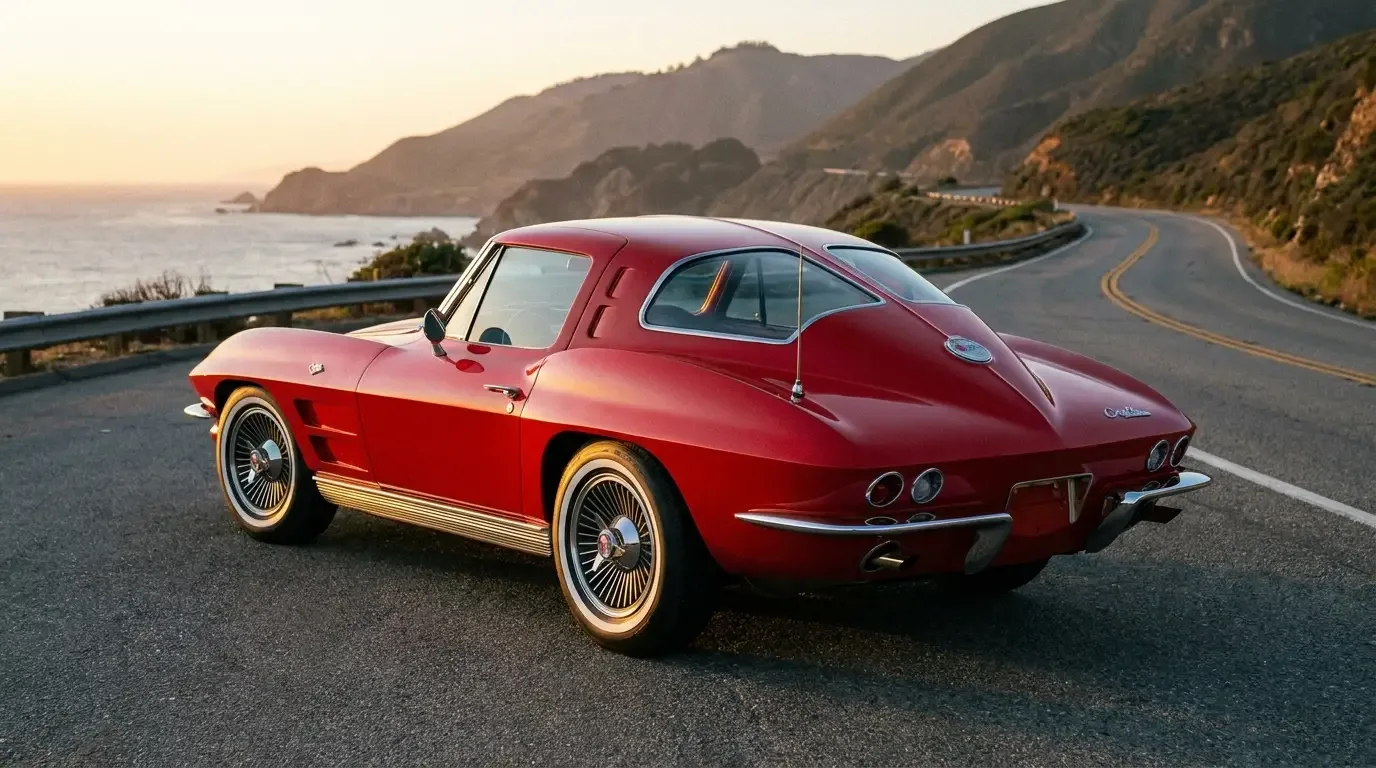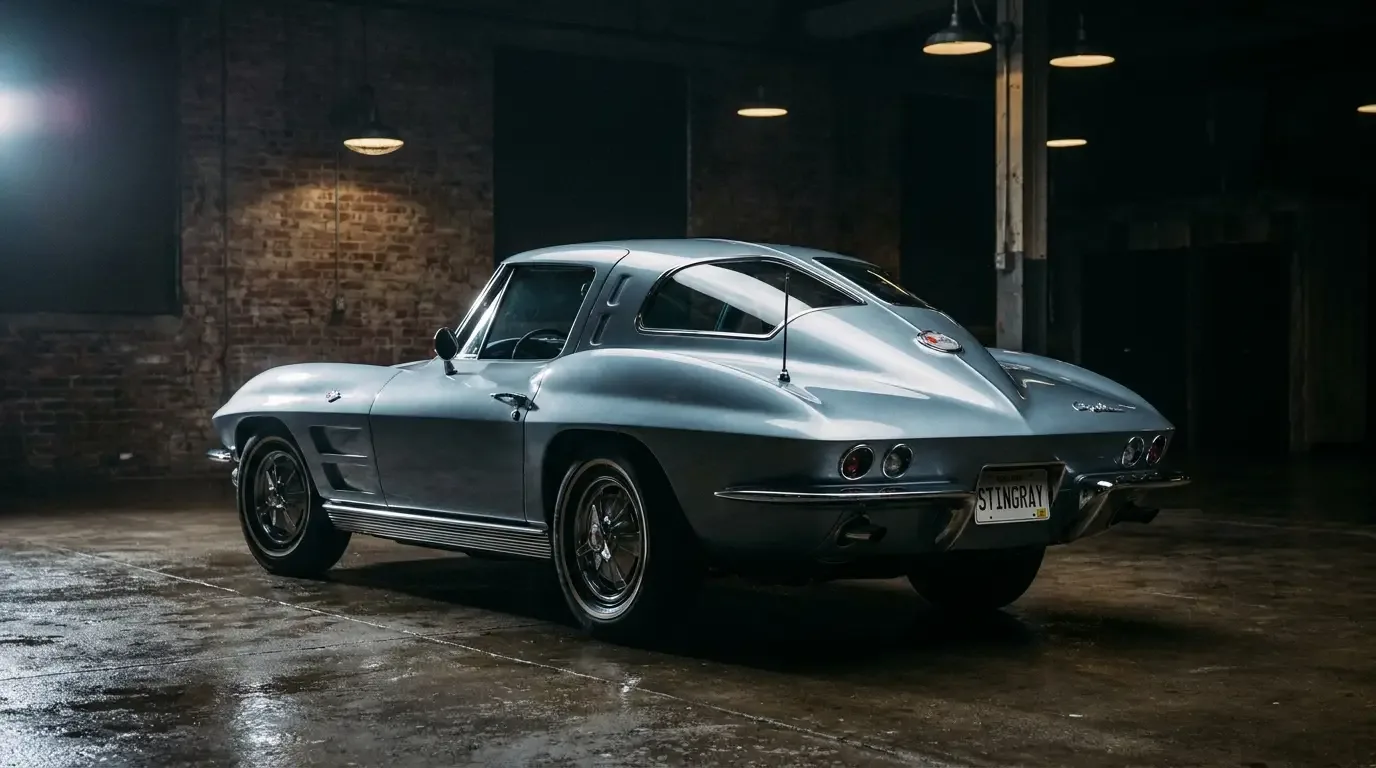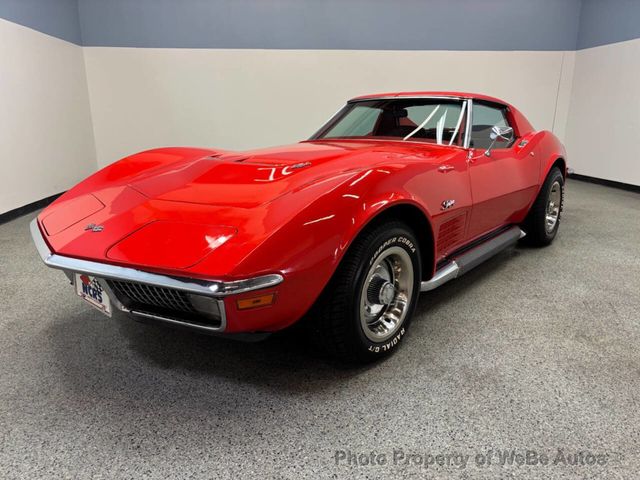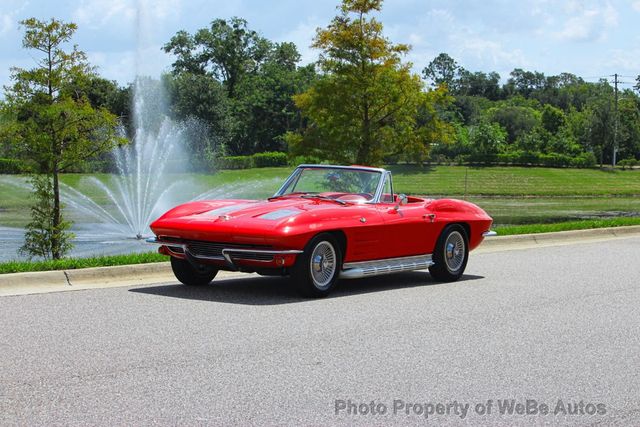

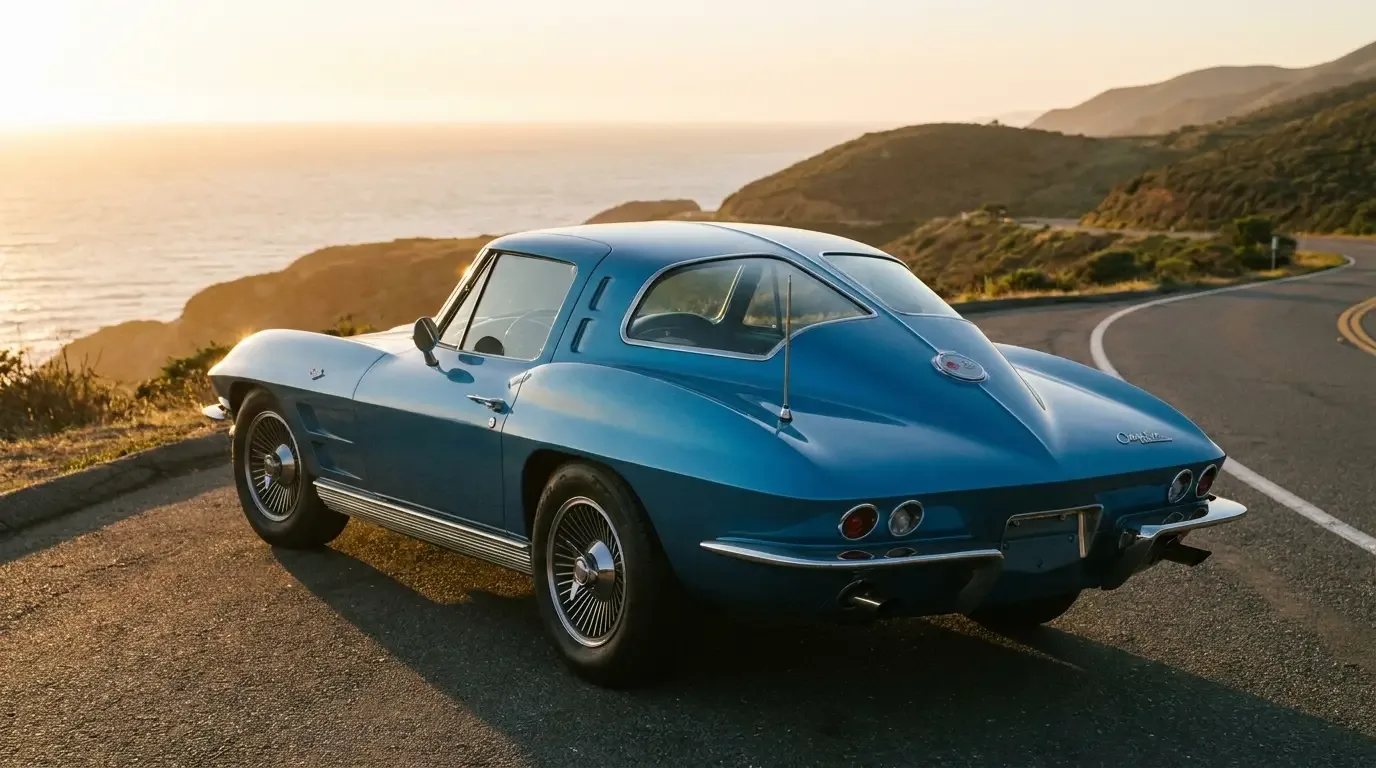
The 1963 Corvette split-window coupe is one of the most immediately recognizable American cars ever built. One model year. One body style. A rear window divided by a vertical spine that Bill Mitchell insisted stay, despite opposition from engineers who argued it blocked rearward visibility. He was right that it looked singular. He was also right that it would not last. Chevrolet removed it for 1964, and that single-year run is a large part of why the split-window commands the prices it does today. For a deeper read on the full generation, see the c2 corvette sting ray story.
What the split window represents in factory documentation terms is a transition point. The C1 body-on-frame architecture gave way to a new ladder frame with independent rear suspension for 1963, a change that transformed how the car drove. The split-window coupe was the showpiece of that engineering shift, and the factory knew it. Production records from the Corvette assembly facility in St. Louis show 10,594 coupes built for the 1963 model year, against 10,919 roadsters, for total production of 21,513 cars, a roughly 50 percent jump over 1962. If you want to understand where the 1963 fits in the full arc of the nameplate, our Corvette history hub covers it from the beginning.
What the split window actually is
The spine running down the center of the rear glass was a styling element, not structural. Mitchell wanted it because it echoed the divided rear screen he had used on the Stingray racer he owned personally. The car's design team built the coupe body around that element. Zora Arkus-Duntov pushed back, correctly noting that the driver's rearward sightline was compromised. Mitchell held firm. For 1964, cooler heads prevailed and the spine came out, leaving a clean single pane of glass that most drivers preferred. That correction, made after one year, is what makes the 1963 coupe the one collectors argue about.
The body itself was fiberglass, carried on the new C2 ladder frame. The independent rear suspension replaced the solid axle used on C1 cars, and the difference in handling was substantial. Road testers at the time noted the improvement immediately. The new frame also allowed the coupe body to sit lower, which helped the car's proportions considerably compared to what the C1 had offered.
Engine options and what they mean for buyers today
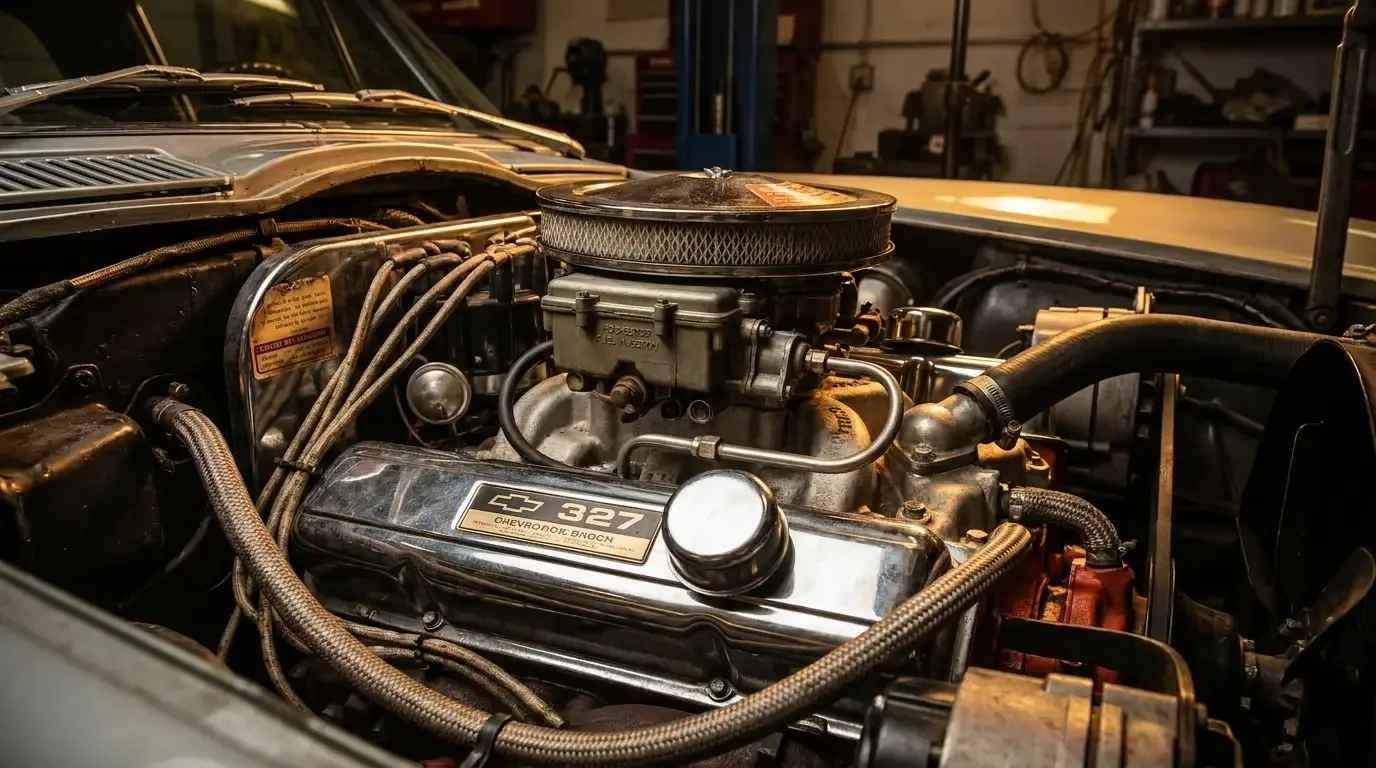
The 1963 Corvette came with several engine choices, all small-block and big-block V8 options depending on RPO selections. The base engine was a 327 cubic inch small block rated at 250 hp, with progressively more aggressive versions available: the fuel-injected 327 at 360 hp, and the solid-lifter 327s in the 300 hp (L75) and 340 hp (L76) configurations. These RPO codes are what buyers and NCRS judges track closely, because the engine installed at the factory determines a significant part of the car's documentation story and its current market value.
| RPO | Engine | Rated HP | Notes |
|---|---|---|---|
| Base | 327 cu in, 2-bbl | 250 hp | Hydraulic lifters, most common |
| L75 | 327 cu in, 4-bbl | 300 hp | Hydraulic lifters |
| L76 | 327 cu in, 4-bbl | 340 hp | Solid lifters |
| L84 | 327 cu in, fuel injection | 360 hp | Rochester Ramjet FI, rare, high value |
The fuel-injected cars carry a significant premium today, both because of their rarity and because Rochester Ramjet fuel injection is something of a specialty unto itself. Finding a car with correct, matching-numbers L84 equipment intact is increasingly difficult. Cars where the FI unit has been replaced with a carburetor are common; restoring them to FI spec is expensive. Buyers interested in the 1963 Corvette market will find current examples listed at 1963 Corvettes for sale, where condition, engine code, and documentation status vary considerably by example.
"The tank sticker on a 1963 split-window tells you everything the factory put on that car the day it left St. Louis. Engine code, transmission, colors, options. A car without its tank sticker isn't necessarily wrong, but the conversation about what's original gets longer immediately."
— Tom Ramirez
The split-window spine: why it was removed
Duntov's objection to the divided rear window was practical and specific. The center spine created a visual obstruction directly in the rearward sightline of a driver of average height. In a car intended to be driven quickly on public roads, that was a legitimate concern. Mitchell understood the objection and disagreed with the priority. The styling element stayed for 1963. For 1964, Chevrolet replaced the split pane with a single piece of curved glass that improved visibility without altering the roofline's silhouette significantly from the outside. If you want the full context on that decision and what it meant for the car's design continuity, read the related story.
What the removal did, in retrospect, was create scarcity. Every 1963 coupe is a split-window by definition. No 1964 coupe is. That one-year exclusivity is not something that happened by design from a collector standpoint, but it functions that way now. Buyers who want the divided window have exactly one model year to work with, and production was finite.
What a split-window costs and what moves the price
The 1963 Corvette split-window coupe market has held firm at the upper end of the C2 range for years, and values vary considerably by engine code. According to Hagerty's valuation data, a carbureted L75 (300 hp) coupe in good driver condition runs roughly $130,000, while a solid-lifter L76 (340 hp) car in the same condition runs closer to $147,000. Fuel-injected L84 (360 hp) cars in good condition have priced around $334,000, and the rarest examples, including numbers-matching Z06 "big tank" cars, have sold well past $1,000,000 at Barrett-Jackson and Mecum in recent years. A base 250 hp coupe in comparable condition typically prices lowest of the group, reflecting the RPO hierarchy across the board.
Several variables move the price considerably. First is engine configuration: a base 250 hp car and a fuel-injected 360 hp car are categorically different purchases at different price points. Second is transmission: the close-ratio four-speed is more desirable than the wide-ratio or the two-speed Powerglide, and that preference is reflected in the market. Third is color: certain exterior and interior combinations from the factory color chart carry collector premiums. Fourth is documentation: a car with its tank sticker, original title history, and NCRS judging history is a different asset than one with gaps in provenance.
The split-window's recognition factor also means it attracts buyers who are not deep Corvette specialists, which can work in both directions. Non-specialist buyers sometimes pay above the fundamentals because they want the distinctive car. They also sometimes miss condition issues that a specialist would catch immediately. Having someone from the NCRS registry look at a car before purchase remains the most reliable way to understand what you are actually buying.
Sources and notes
- CorvSport, 1963 Corvette Production Numbers: confirmed 10,594 coupes and 10,919 roadsters, 21,513 total units for the 1963 model year
- CorvSport, 1963 Corvette Performance & Specifications: confirmed base 250 hp, L75 300 hp, L76 340 hp, and L84 360 hp fuel-injected engine ratings
- National Corvette Museum, 1963 Chevrolet Corvette Specs: manufacturer-adjacent reference for 1963 model year specifications
- Hagerty Valuation Tools, 1963 Chevrolet Corvette: confirmed current market values by RPO/engine code, including L75, L76, and L84 pricing tiers
- National Corvette Restorers Society (NCRS): confirmed 1963-1967 Sting Ray designation and Z06 package details, including the 199-unit Z06 production figure
- Vette Vues, 1963 Corvette Z06 Split-Window Coupe Auction: confirmed recent high-profile Mecum and Barrett-Jackson results for fuel-injected and Z06 split-window coupes