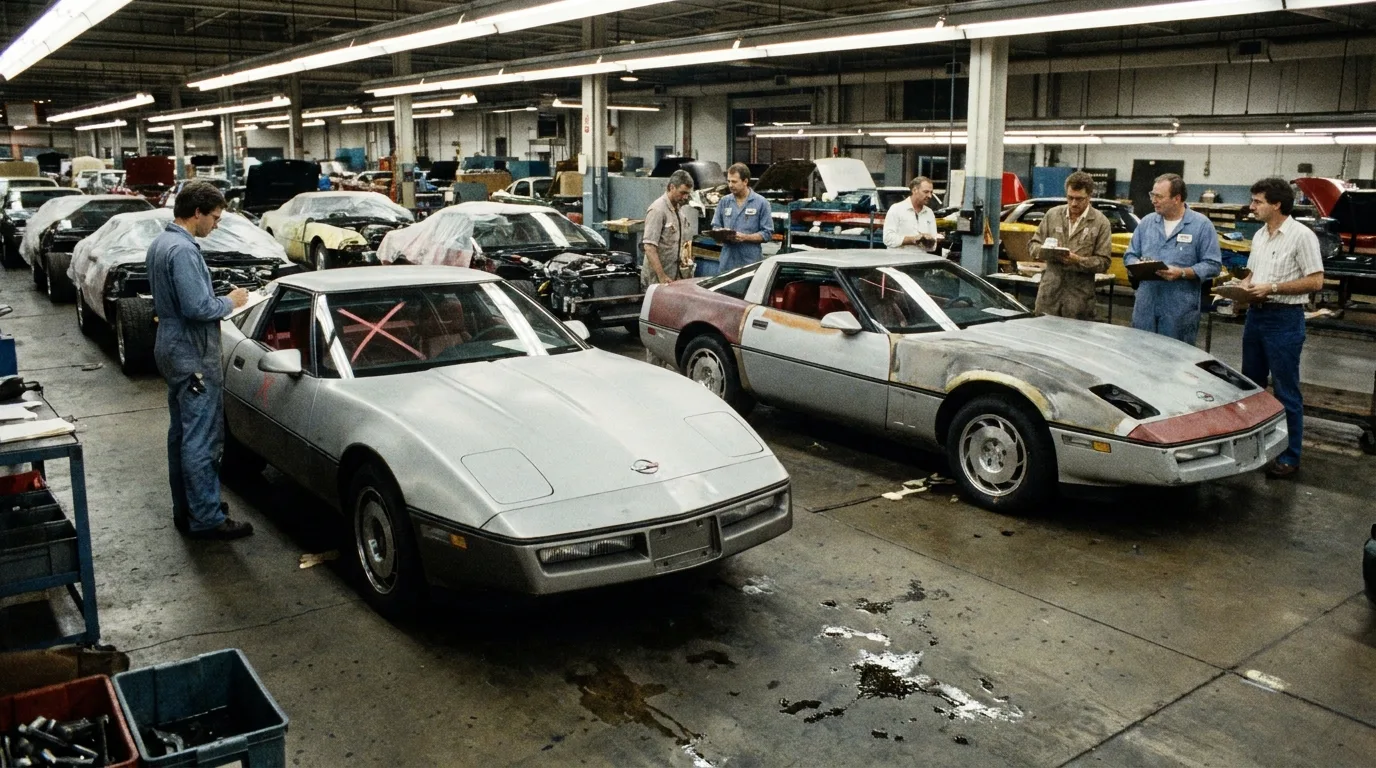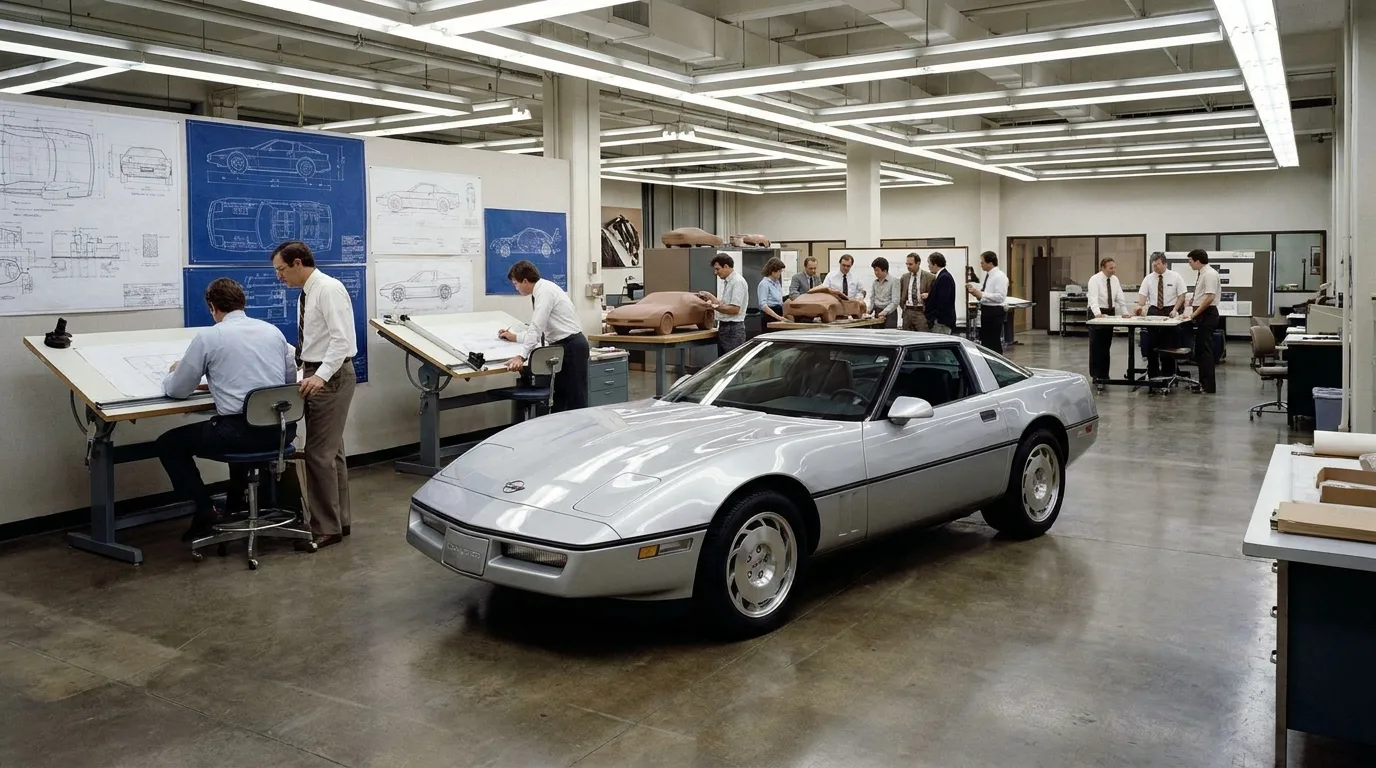
The 1984 Corvette did not arrive quietly. Development ran long enough that Chevrolet skipped a 1983 model year entirely, extending C3 production into early 1983 before the c4 corvette launched as the most complete redesign the nameplate had seen since 1963. New chassis, new body, new interior, new instrument panel. The factory records show just how deliberate that reset was.
What the C4 accomplished on the design front is worth understanding on its own terms. Not every change was popular. Some were reversed. But the decisions made between 1979 and 1983 in the GM studios and the Bowling Green engineering offices set the visual and structural direction for a generation of Corvette.
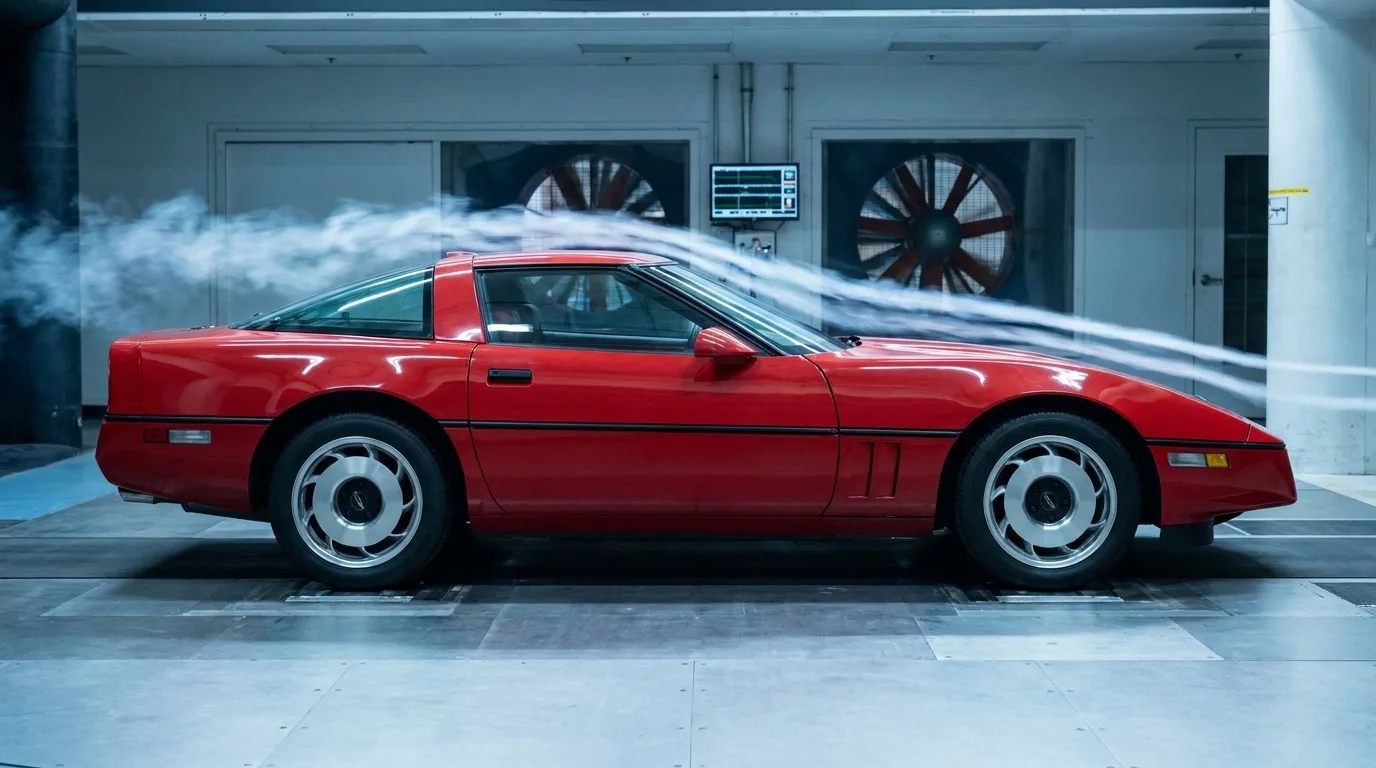
Starting from scratch: the clamshell body
The C3's fiberglass body had accumulated years of incremental changes, and by 1982 it showed. The C4 team, working under chief engineer Dave McLellan, committed to a unified clamshell structure: a front end that tilted forward as a single piece, exposing the entire engine compartment, and a rear section that lifted to reveal the spare and storage. No conventional hood or trunk lid. The concept had engineering logic behind it, but it also required buyers to adapt to a car that opened differently than anything they had owned before.
The windshield rake was steeper than any production Corvette before it, at 64 degrees from vertical, which pushed the A-pillars back and created the low, stretched profile that reads clearly even at a distance. The roofline was lower than the C3's by a meaningful margin. All of this required a new approach to the greenhouse: the C4's interior felt tighter initially, though the actual cabin volume was competitive with European contemporaries.
The instrument panel gamble
Inside, the C4 made a decision that proved more controversial than the exterior. The 1984 model year launched with a fully digital instrument cluster: bar graphs for speed and rpm, digital readouts for everything else. The reasoning was straightforward from an engineering standpoint. Digital displays were more precise, they aged better than mechanical gauges, and they matched the forward-looking image GM wanted to project.
The market did not fully agree. Starting with the 1990 model year, GM replaced the all-digital cluster with a hybrid design: analog gauges for tachometer, oil pressure, voltage, and fuel, paired with a digital LCD readout for the speedometer. It was less a buyer-selectable option than a running design change, and it effectively ended the fully digital dash after six model years (1984-1989). The original digital cluster has its defenders today, particularly among collectors who want a correct early C4. But the episode illustrates how much the design team was willing to depart from convention, and how quickly consumer feedback could redirect a decision.
For a closer look at the engineering thinking behind the C4's development, a related piece on McLellan's tenure covers how his team prioritized chassis rigidity and aerodynamics over raw power, at least in the early years.
Aerodynamics as design language
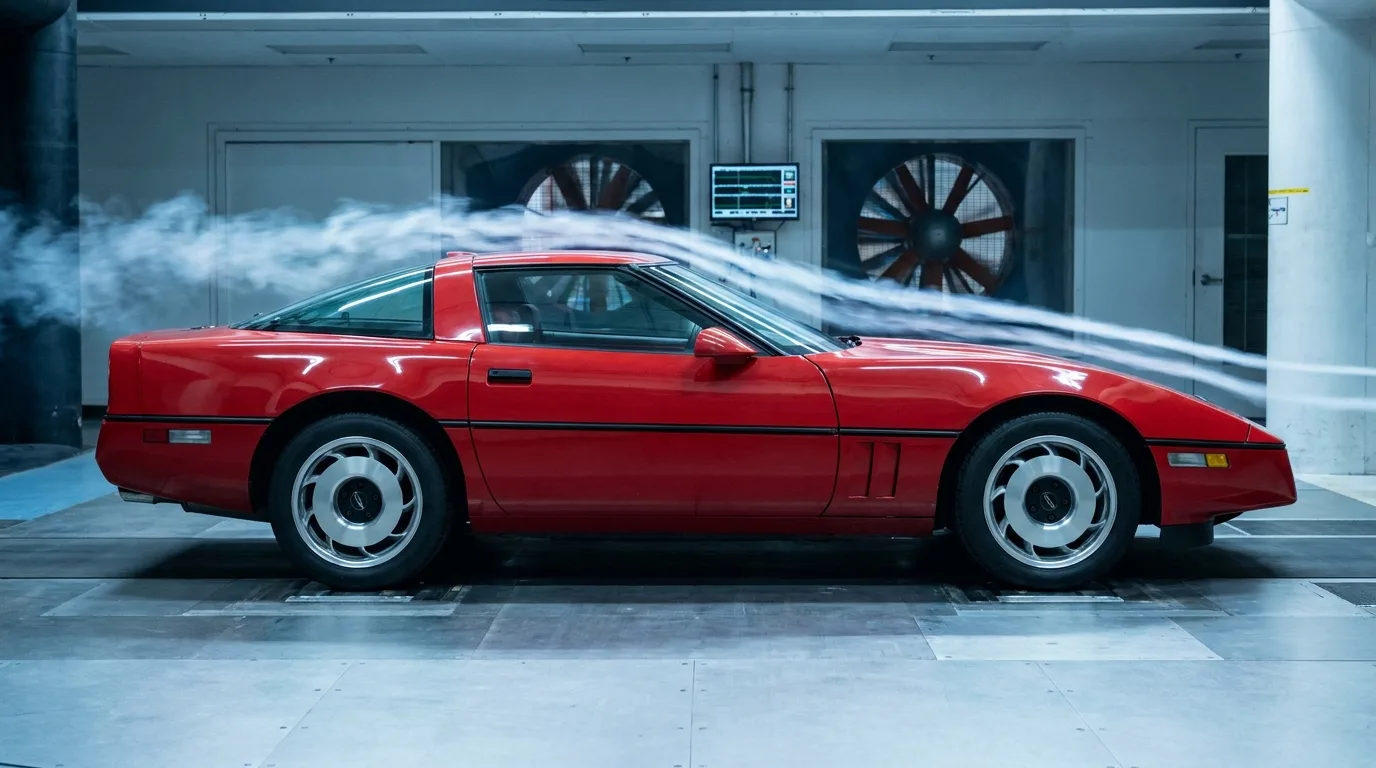
The C4's drag coefficient came in at 0.34 Cd, a roughly 23 percent improvement over the outgoing C3's figure, and it was competitive for a production sports car in 1984. That number was not accidental. The body was shaped extensively in GM's wind tunnel, and several features that looked like styling choices were actually aerodynamic decisions: the flush glass, the integrated front fascia, the lack of traditional bumper protrusions.
The pop-up headlights continued from the C3, not because anyone loved the mechanism, but because federal regulations of the era required headlamps of a fixed minimum height, and pop-ups were the cleanest engineering solution for a low-nosed car. The C4 kept pop-up headlights for its entire run, through the final 1996 model year; the switch to flush composite headlights on the Corvette did not happen until the C5 arrived for 1997. What did change for 1991 was the front and rear fascia: a revised bumper cover, a convex rear treatment borrowed from the ZR-1's look, and color-matched moldings replaced the black rubber trim used through 1990. The change made the car read lower and cleaner, even though the headlight mechanism and overall dimensions did not change.
| Model years | Headlights | Instrument cluster | Notable exterior change |
|---|---|---|---|
| 1984 | Pop-up, sealed beam | Digital only | Launch year, no convertible |
| 1986 | Pop-up, sealed beam | Digital only | Convertible returns to lineup |
| 1990 | Pop-up, sealed beam | Hybrid analog/digital | ZR-1 joins lineup |
| 1991 | Pop-up, sealed beam | Hybrid analog/digital | Front and rear fascia revision, convex tail styling for all C4s |
| 1996 | Pop-up, sealed beam | Hybrid analog/digital | Grand Sport, Collector Edition |
The ZR-1 and what it did to the body
When the ZR-1 arrived for 1990, the factory needed to accommodate the LT5 engine's wider Lotus-designed block and the massive 315/35-17 rear tires it required. The solution was a wider rear body section, about three inches wider overall than a standard C4's rear track, to cover the fatter tires. From the rear, a 1990-1991 ZR-1 is immediately distinguishable from a standard C4 by those squared-off haunches. Standard C4s of that era had a rounded, concave tail with round taillights. The ZR-1's tail was convex, broader, flatter, with rectangular taillights.
The factory made one additional distinction in those first two years: the ZR-1's convex rear fascia and rectangular lights were unique to it, while standard cars kept the concave tail and round lights. That changed for 1991, when the convex rear treatment (though not the ZR-1's extra body width) was extended to the entire C4 lineup. The wider rear body itself became something buyers tried to replicate on non-ZR-1 cars through aftermarket kits, which created its own authentication headache for later buyers trying to determine what they were actually looking at.
"The ZR-1's wider rear body is not purely cosmetic, and anyone who tells you it is has not looked at the engineering drawings. The rear track is wider, the tires are wider, the suspension pickup points are different. The body follows the engineering, not the other way around."
— Tom Ramirez
What the C4's design legacy actually is
By 1996, the C4 had run twelve model years with remarkably consistent visual identity. The clamshell stayed. The low roofline stayed. The proportions that made the car look wider and lower than its predecessor were confirmed, not revised. When the C5 arrived for 1997, it built directly on the C4's dimensional logic while cleaning up the details the 1984 team had not fully resolved.
The C4's design revolution was not about dramatic styling in the way the C2 Sting Ray had been. It was about committing to a set of engineering-driven proportions and then holding them through market pressure, regulatory changes, and a full decade of model-year updates. That kind of consistency is rarer than it looks. The C4 held its shape because the shape was based on something real.
If you want to understand how this generation fits into the full history of the marque, the bigger picture covers the Corvette from its 1953 origins through the generations that followed.
For buyers who want to own a piece of this era, there is genuine variety available across the production run. Early cars with the digital cluster are increasingly sought by collectors who want the full 1984 experience. ZR-1s command a premium for the wider body and the LT5 engine. The 1996 Grand Sport and Collector Edition represent the final statement from the C4 design team. Browse C4 Corvettes for sale to see what the current market looks like across those variants.
Sources and notes
- National Corvette Museum, 1984 Corvette Specs: confirmed the 64-degree windshield rake and 0.34 Cd drag coefficient
- Hagerty, on the missing 1983 model year: confirmed the C4's delayed launch and why there was no 1983 Corvette
- Wikipedia, Dave McLellan: confirmed his role as Corvette chief engineer (1975-1992) and correct name spelling
- CorvSport, 1990 Corvette Pricing, Factory Options & Colors: confirmed the 1990 hybrid analog/digital instrument cluster redesign
- CorvetteForum, headlights by Corvette generation: confirmed pop-up headlights were used on every C4 model year, 1984-1996, with flush composite headlights not arriving until the C5
- CorvetteForum, C4 ZR-1 discussion: confirmed the ZR-1's convex tail with rectangular taillights versus the standard car's concave tail and round taillights, and that the convex rear treatment spread to the full C4 lineup for 1991