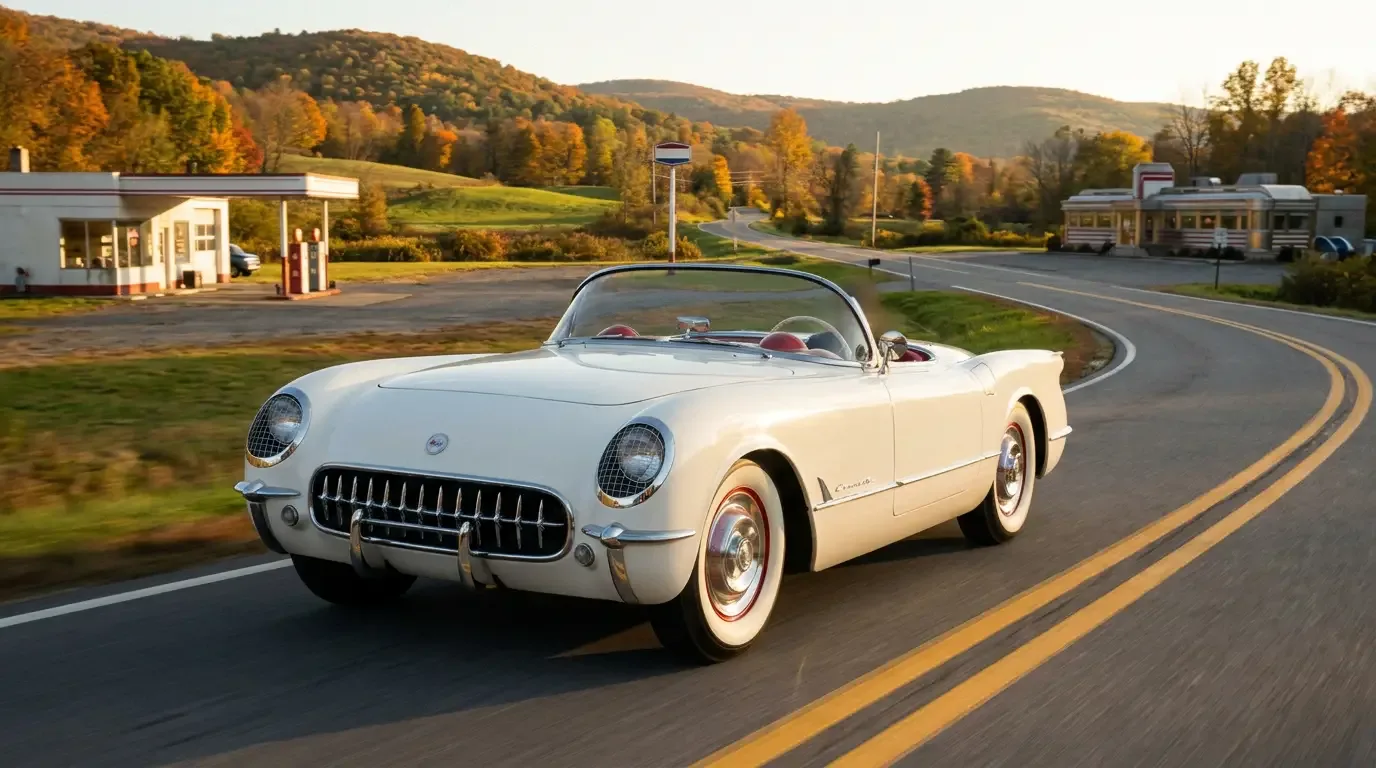

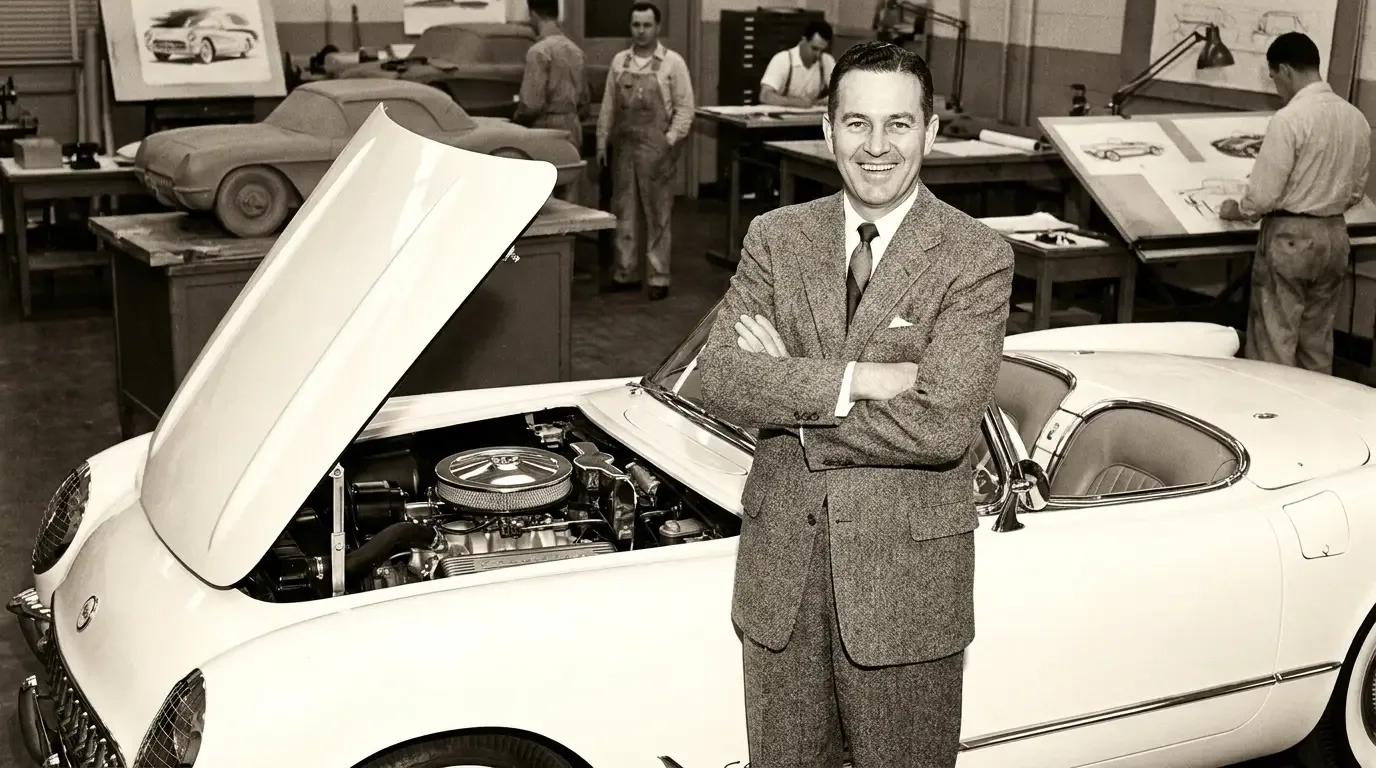
Ed Cole was not the man who invented the Corvette. That story belongs to Harley Earl and Myron Scott and the team that rushed a fiberglass roadster onto the floor at the 1953 Motorama. But Cole was the man who turned the Corvette into something that could actually win an argument. He did it with one decision that changed the car's trajectory entirely: he put a V8 under the hood. Not just any V8. The small-block that Cole had spent two years developing from nearly a clean sheet.
To understand why that mattered, you have to understand what the Corvette was before 1955. The C1 Corvette debuted with a 235-cubic-inch inline-six, the "Blue Flame Six," borrowed from Chevrolet's passenger car lineup and tuned with a higher compression ratio and a hotter camshaft. It made 150 horsepower at 4,200 rpm with a trio of single-barrel carburetors bolted on to make it look serious. The two-speed Powerglide automatic was the only transmission available in 1953 and 1954. Road testers were polite. Buyers were not. Sales in the first two years were so poor that Chevrolet came very close to canceling the whole program.
The man behind the engine
Cole had arrived at Chevrolet from Cadillac in 1952 as chief engineer, and he was promoted to general manager in 1956. Born in 1909, he was in his early forties when he took the Chevrolet job, and he had already co-led the team that developed Cadillac's overhead-valve V8 for 1949, one of the most admired engines of its era. He brought that experience and a particular engineering philosophy to Chevrolet's new V8 project: keep it light, keep it compact, and make it easy to build.
The 265-cubic-inch small-block V8 that debuted in Chevrolet's passenger cars for 1955 was a departure from conventional American engine design in ways that mattered. Stamped steel rocker arms instead of the machined castings typical of the period. A high-rise intake manifold that improved breathing. A design compact enough to fit transversely if needed, though that was not the point. The new V8 was noticeably lighter than the inline-six it replaced in the Corvette, even as it produced significantly more power in base form.
What the V8 did for the Corvette
The 1955 Corvette could be had with the 265 V8 producing 195 horsepower at 5,000 rpm with its four-barrel carburetor, paired with a manual gearbox option that finally arrived that same year. The combination changed what the car was. Not just in terms of acceleration, though that improved substantially. The V8 changed the conversation about the Corvette as a serious sports car. It gave automotive writers something to actually write about. It gave enthusiasts a reason to consider it against the European sports cars that had previously owned that category.
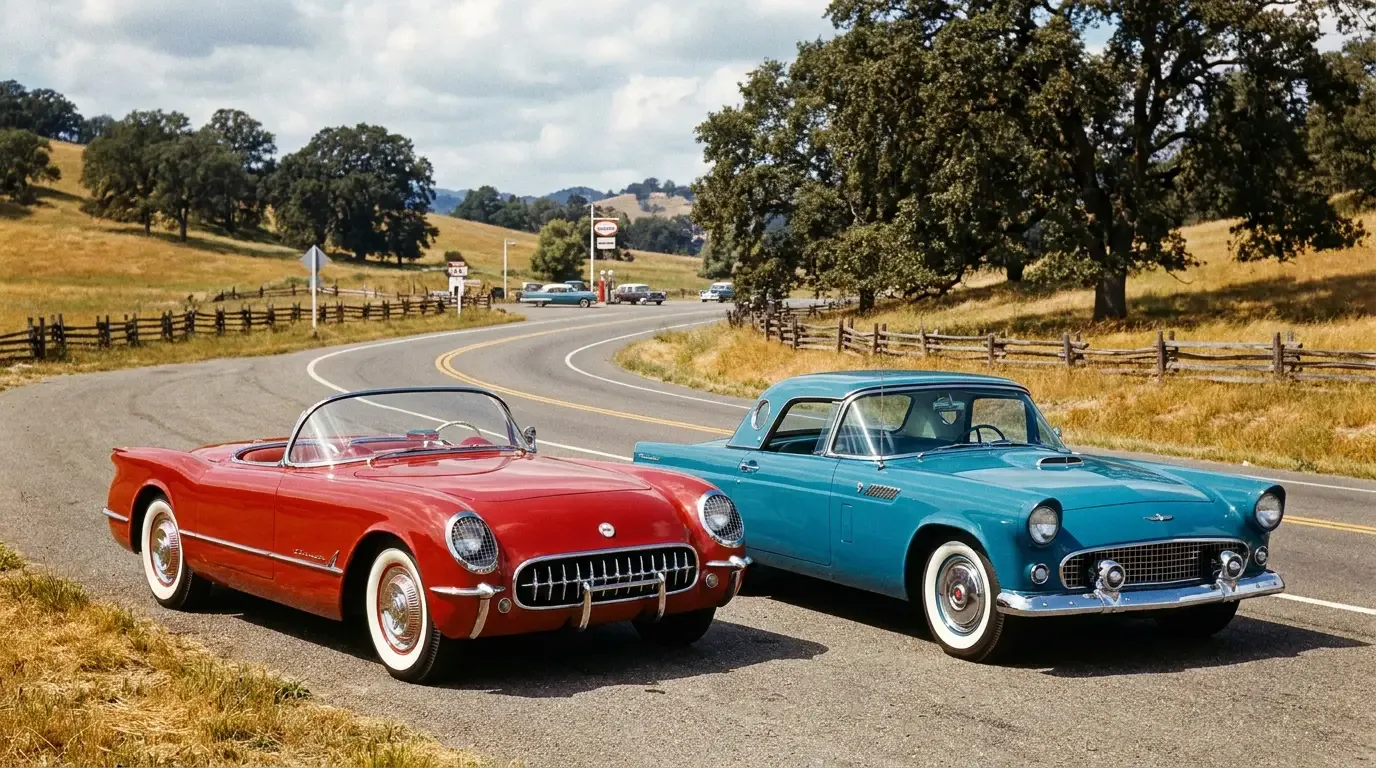
Ford had introduced the Thunderbird for 1955 as well, and the competition between the two cars shaped how Chevrolet thought about the Corvette's future. You can read more about how that played out in the related article on that early rivalry. The short version is that the Thunderbird outsold the Corvette by a significant margin in 1955, but the Corvette had the engine that would define the sports car segment for the next two decades.
| Year | Engine | Output (approx.) | Transmission options |
|---|---|---|---|
| 1953-54 | 235 cu-in inline-six | 150 hp | 2-speed Powerglide only |
| 1955 | 265 cu-in V8 | 195 hp | Powerglide or 3-speed manual |
| 1956 | 265 cu-in V8 (revised) | 210-225 hp (240 hp "Corvette Special" option) | 3-speed manual standard |
| 1957 | 283 cu-in V8 | 220-283 hp | 3-speed manual, optional 4-speed |
The 283 and what came next
Cole's engineering team did not rest on the 265. For 1957, they bored and stroked it to 283 cubic inches and introduced fuel injection as an option, producing a claimed one horsepower per cubic inch in the most aggressive version. That figure was significant in 1957, a kind of psychological benchmark in American performance engineering. The fuel-injected 283 became part of the classic Corvette story in ways that still resonate with collectors and historians.
The small-block architecture Cole's team had established with the 265 proved durable enough to serve the Corvette for decades. The basic family expanded to 327 cubic inches, then 350, with power outputs that ranged from modest daily-driver numbers to the 350-horsepower L79 327 option of the mid-1960s. The block design changed in increments, but the fundamental approach Cole had locked in for 1955 remained the foundation.
"Cole's small-block wasn't just a better engine for the Corvette. It was the engine that made the Corvette's argument for it. Before 1955, you could debate whether the car deserved to exist. After 1955, that conversation was over."
— Patrick Walsh
Why this history matters to buyers today
If you follow the Corvette collector market at all, you know that the 1955 V8 cars occupy a specific place. They are the rarest of the early Corvettes by production count, with just 700 built for the 1955 model year, and the great majority of them left the factory with the new V8. The inline-six cars from 1955 are rarer still by virtue of being early production, but the V8 is what people seek. A 1956 or 1957 Corvette with the fuel-injected 283 can command prices that reflect both the mechanical significance and the relative scarcity of well-documented examples.
Anyone seriously looking at early small-block Corvettes should understand what they're evaluating. The engine itself is not a fragile piece, but decades of modifications, rebuilds, and swapped components have complicated the documentation picture for many survivors. Authenticity questions around the 1957 fuel-injection system in particular require expert verification. If you want to shop the early cars properly, start by looking at first-gen Corvettes for sale and filter by year once you know which configuration you're targeting.
Cole's legacy beyond the displacement numbers
Ed Cole became Chevrolet's general manager in 1956 and eventually president of General Motors in 1967, a post he held until 1974. The small-block V8 he shepherded into production outlasted his tenure and then some. By the time GM finally retired the traditional pushrod small-block from the Corvette lineup, it had been in continuous development for more than four decades in various forms.
The decision to put that engine in the Corvette in 1955 was not a sure thing from Cole's position. The program was struggling. There was genuine corporate pressure to cancel it. The V8 conversion required engineering work that could have been redirected elsewhere. Cole made the call anyway. The car that resulted was different enough from the 1953-54 six-cylinder version that it earned a second hearing from buyers and press alike.
That is the part of the story that tends to get lost in the specification tables and production numbers. The small-block V8 was not just a performance upgrade. It was the intervention that kept the Corvette alive long enough to become what it eventually became. Every C2, C3, and later generation Corvette is downstream of that 1955 decision in a direct line. Cole had a lot to do with that.
Sources and notes
- Wikipedia: Ed Cole biography confirmed his 1909 birth year, 1952 arrival as Chevrolet chief engineer, 1956 promotion to general manager, and 1967-1974 tenure as GM president.
- CorvSport: 1953-55 Stovebolt Six engine guide confirmed the 235-cubic-inch Blue Flame Six's 150-horsepower rating and triple-carburetor setup.
- Vette Vues: 1955 Corvette brochure pages confirmed the 265-cubic-inch V8's 195-horsepower rating for 1955 and the arrival of the manual transmission option.
- CorvSport: 1956 Corvette factory options confirmed the 1956 power spread of 210, 225, and 240 horsepower across the revised 265 V8.
- MotorCities National Heritage Area: One Horsepower Per Cubic Inch confirmed the 1957 fuel-injected 283's 283-horsepower rating and its status as the first American production engine to hit one hp per cubic inch.
- Corvette Forum: 1955 production feature confirmed total 1955 Corvette production of 700 units.
- Classic.com: Corvette L79 327/350 market data confirmed the L79 was a 327-cubic-inch engine rated at 350 horsepower, offered from 1965.