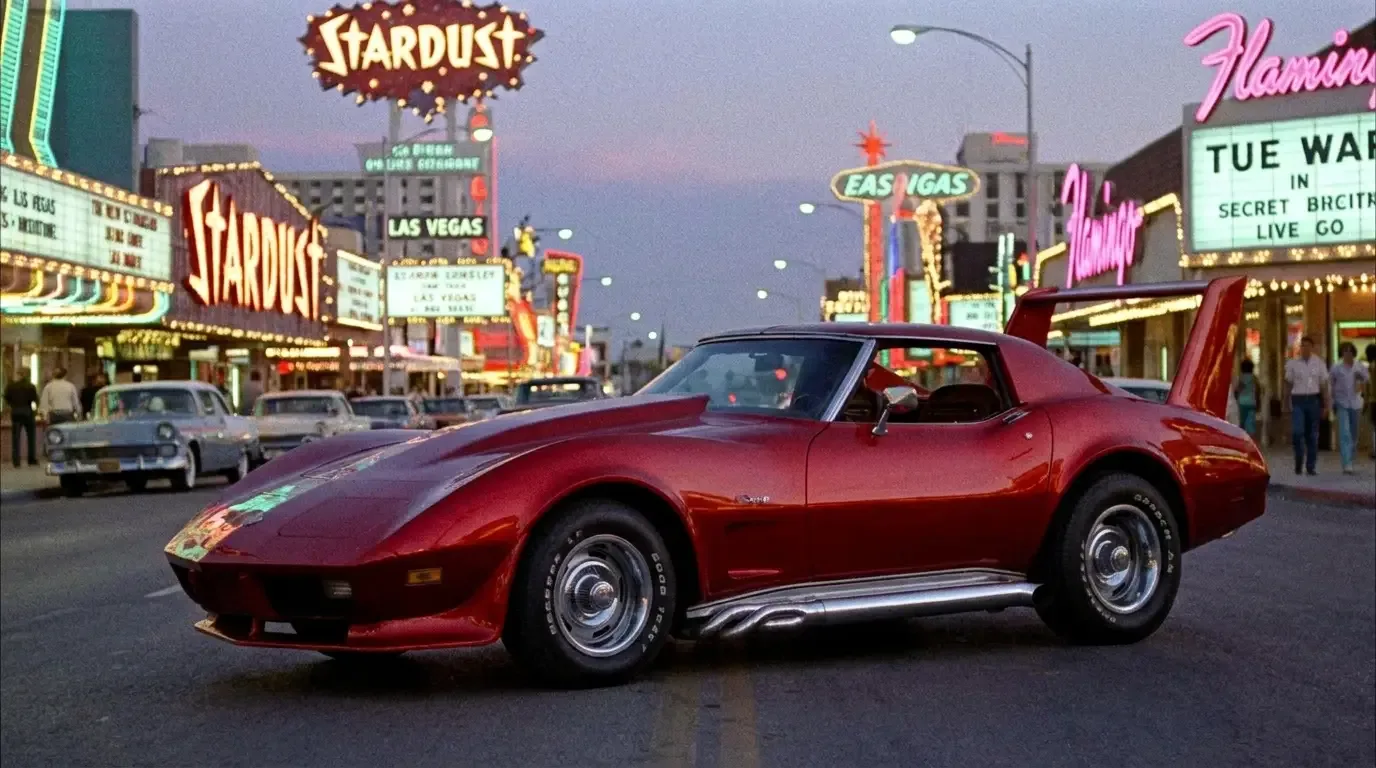

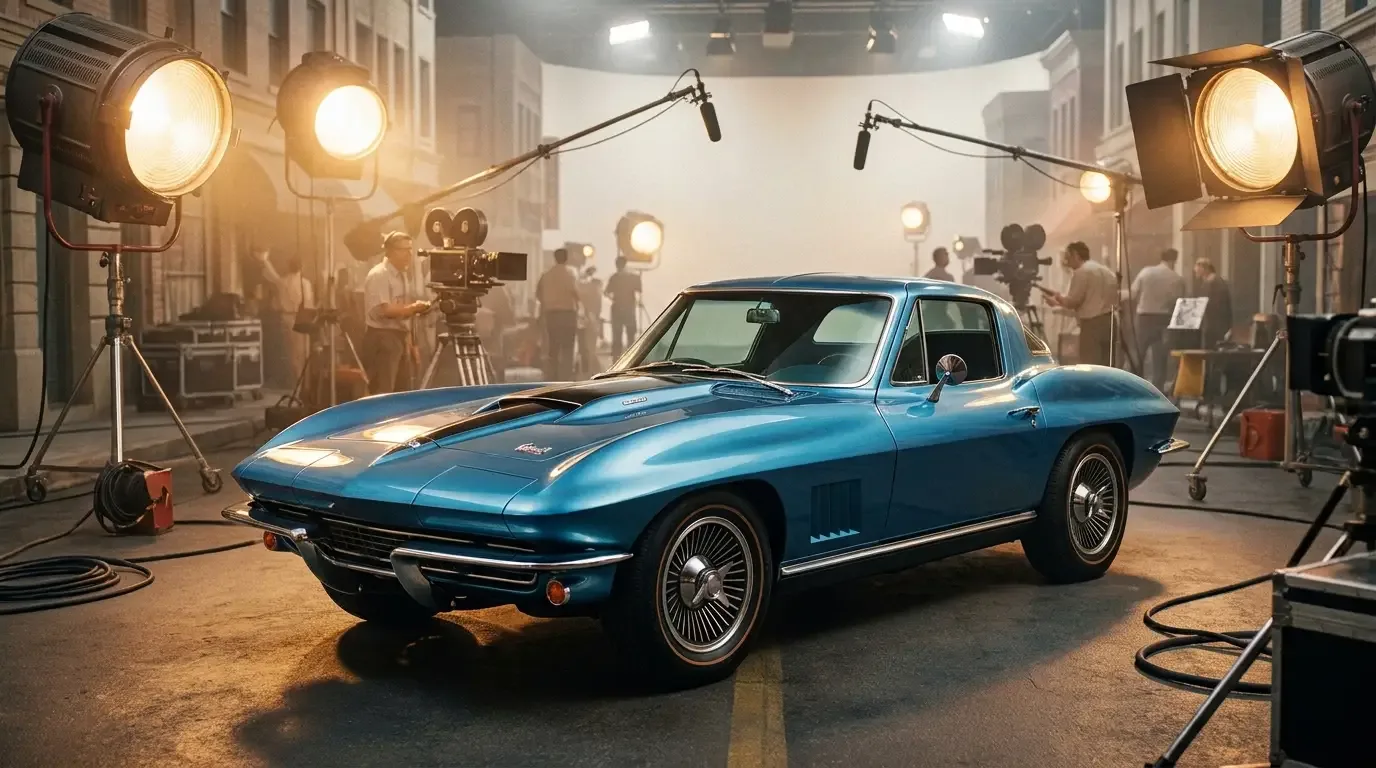
There is a particular scene in the pilot episode of Vega$ that I keep coming back to. Not the plot. Not the actors. It is the Corvette. A yellow 1967 split-window coupe parked outside a hotel on the Las Vegas strip, catching the Nevada sun at an angle that makes it look less like a production car and more like something a studio prop department built for a science fiction movie. The car does not need to be explained. Every American watching that screen in 1978 already knew what it meant. Fast. Modern. Ours.
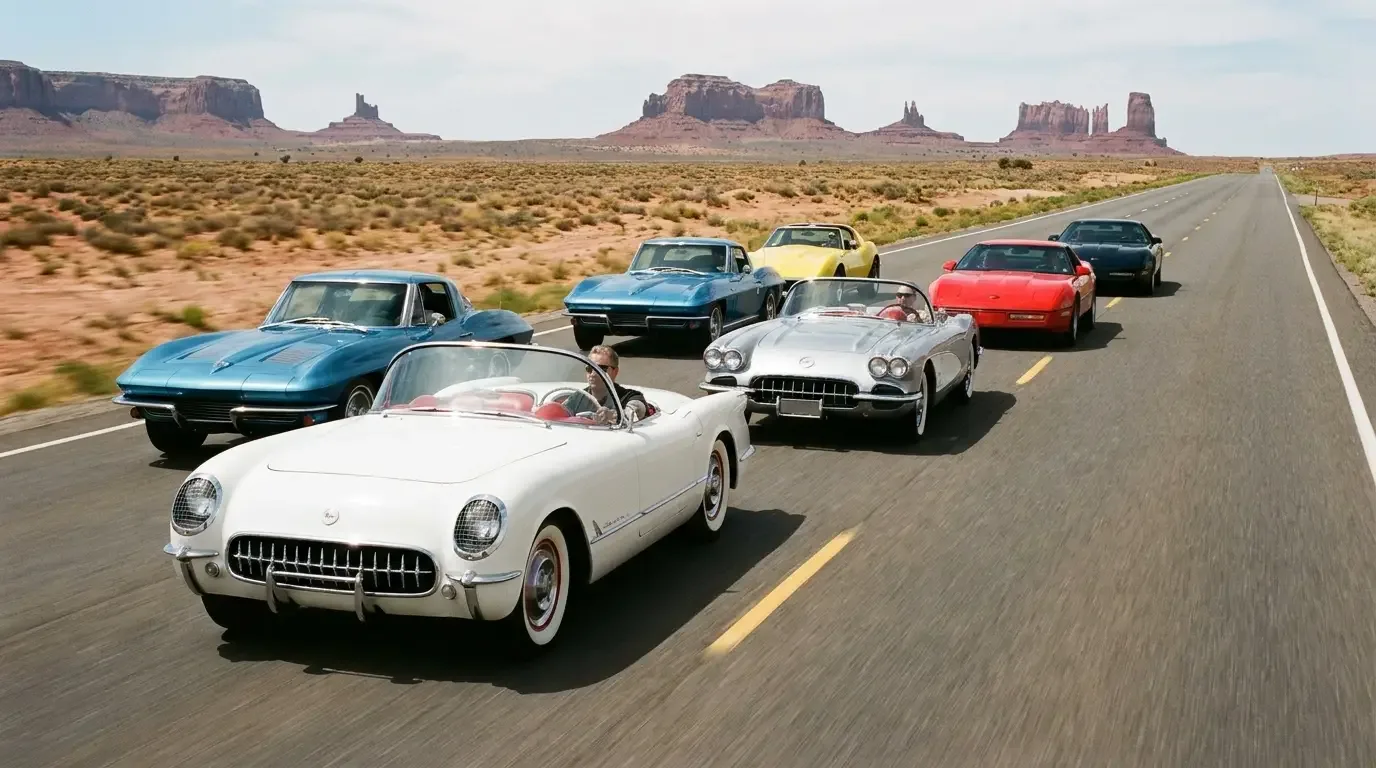
The Corvette has been doing that work since 1953: standing in for an idea. Not just a sports car that happens to appear in movies and television, but an object that American culture reached for whenever it needed a shorthand for freedom, ambition, or arrival. The story of Corvette's full legacy runs through race tracks and design studios, but it also runs through Hollywood back lots, NASA press releases, and forty years of advertising copy. That cultural thread is worth following on its own.
Route 66 and the car that made a generation dream
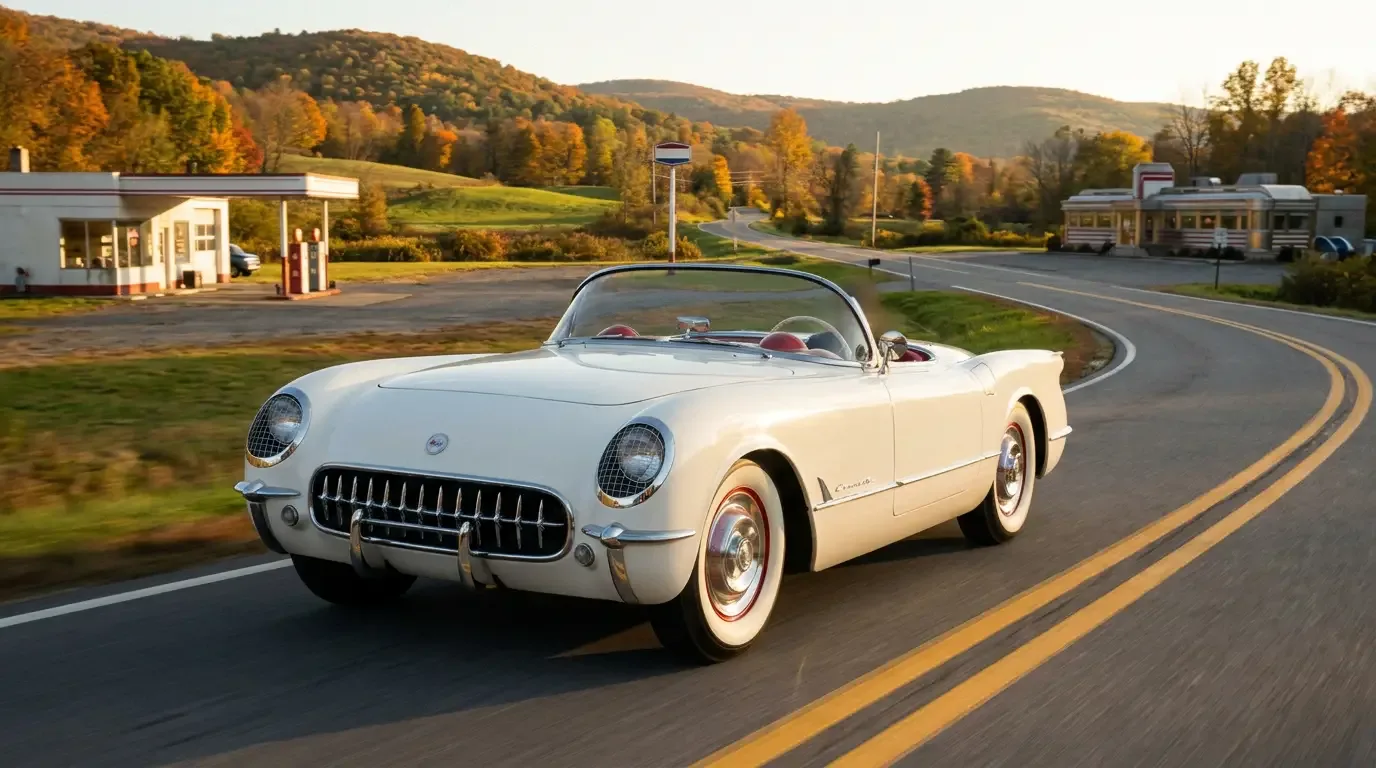
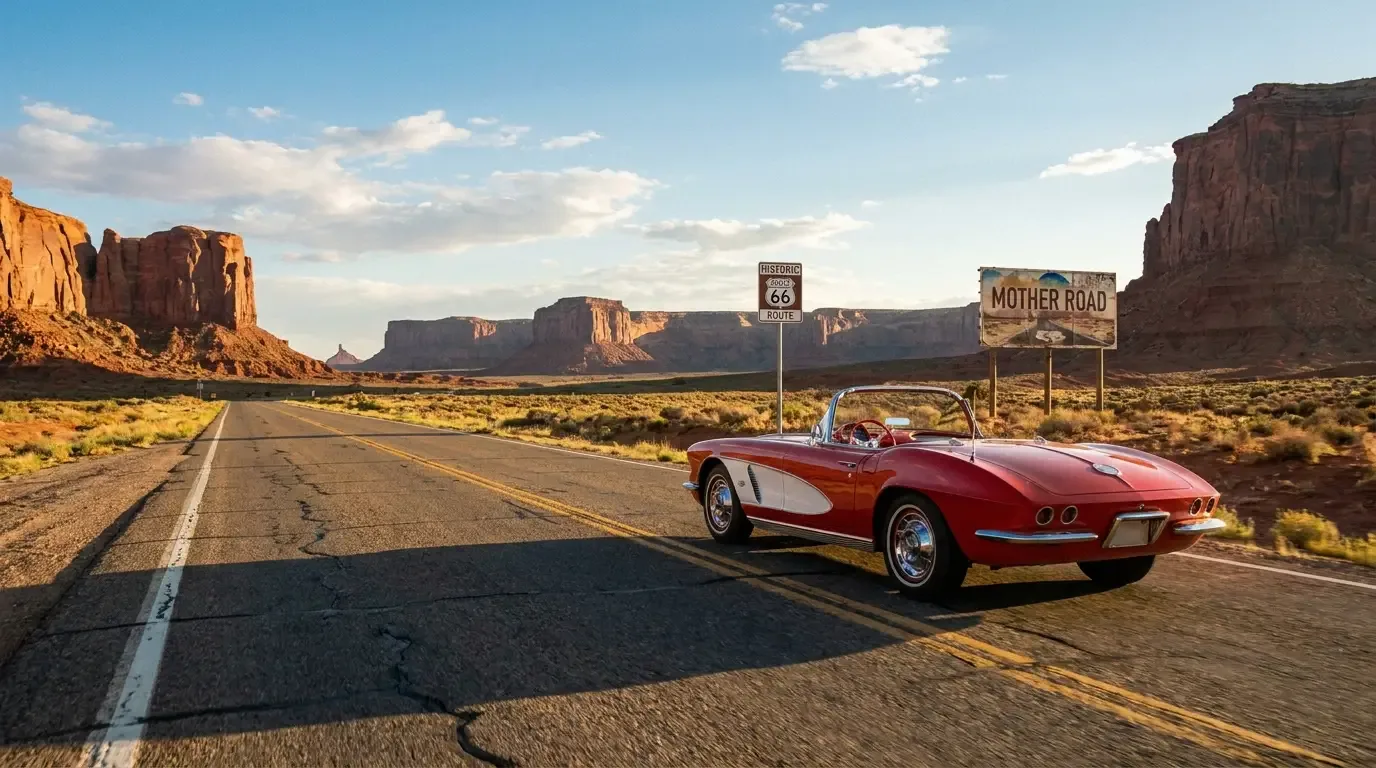
The CBS series Route 66 ran from 1960 to 1964, and it did something unusual for prime-time television: it put two young men in a Corvette and sent them across America. Tod Stiles and Buz Murdock drove a Corvette roadster from town to town, taking odd jobs, meeting strangers, getting into trouble. The setup was simple enough. The effect on the American imagination was not.
Chevrolet supplied the production vehicles directly, cycling in new model-year cars as the show progressed. Viewers watched the Corvette evolve in real time through the early 1960s, the car changing subtly each season while the road stayed the same. The show made the Corvette seem attainable, which was partly the point. It was not a European sports car driven by socialites at Pebble Beach. It was an American car on American roads, driven by Americans who were working things out.
The timing mattered enormously. Route 66 premiered the same year the C1 generation was nearing the end of its run and Zora Arkus-Duntov was fighting internally to turn the Corvette into a genuine performance machine rather than a styled boulevard cruiser. The television audience that fell in love with the car on screen had no idea about those production arguments. They just knew the car looked right on a desert highway at dusk.
Hollywood discovers a symbol
After Route 66 established the grammar, other productions borrowed it freely. The Corvette became a reliable piece of visual shorthand: park one in a scene and the audience immediately understood something about the character driving it. Successful. American. Not afraid to move fast.
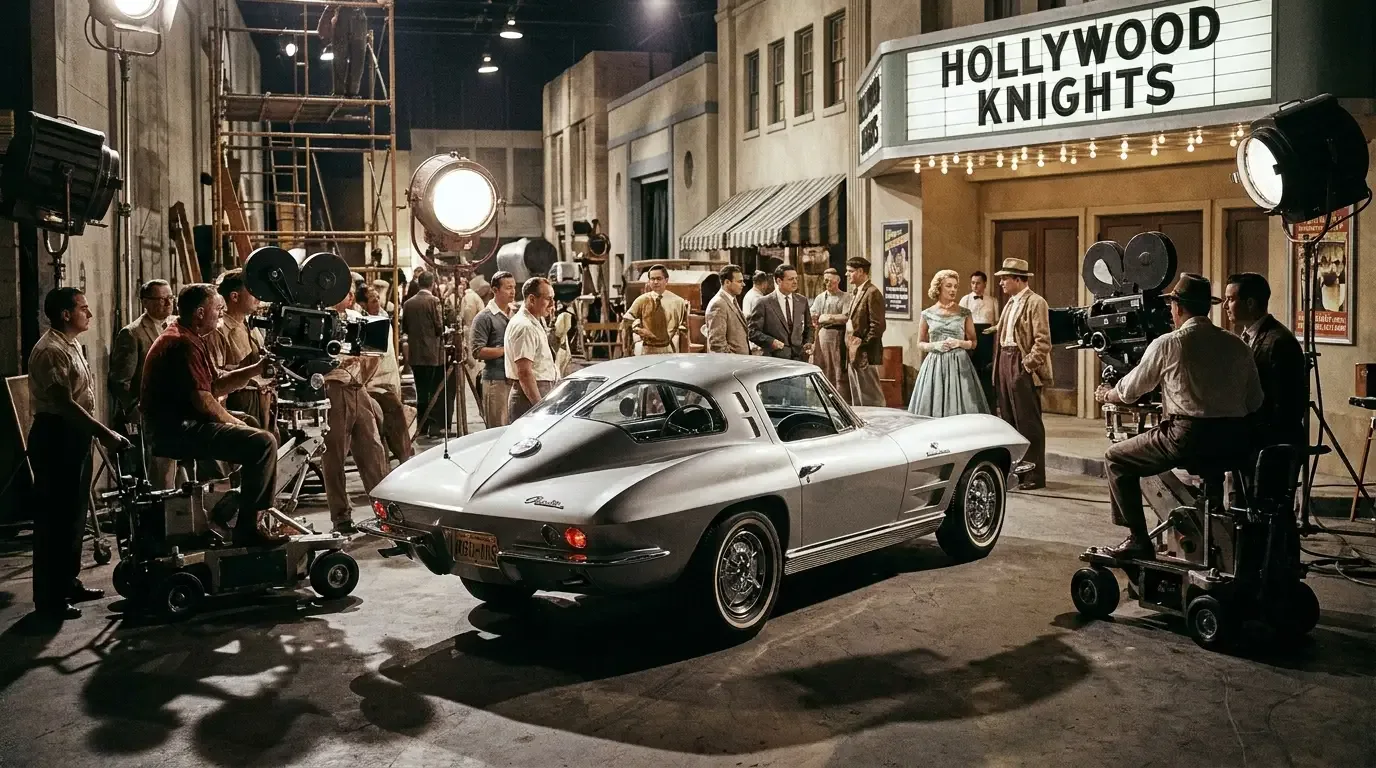
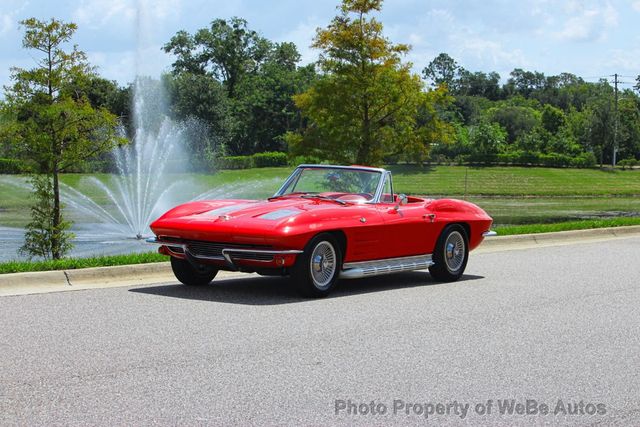
The car showed up in films across genres throughout the 1960s and 1970s. It appeared in youth movies and detective stories and car-chase films that were less interested in the mechanics than in what the car communicated at a glance. The Stingray body, introduced for 1963, helped enormously. That shape was genuinely distinctive in a way that later made it an instant period marker: see a C2 in a film, and you know exactly when you are.
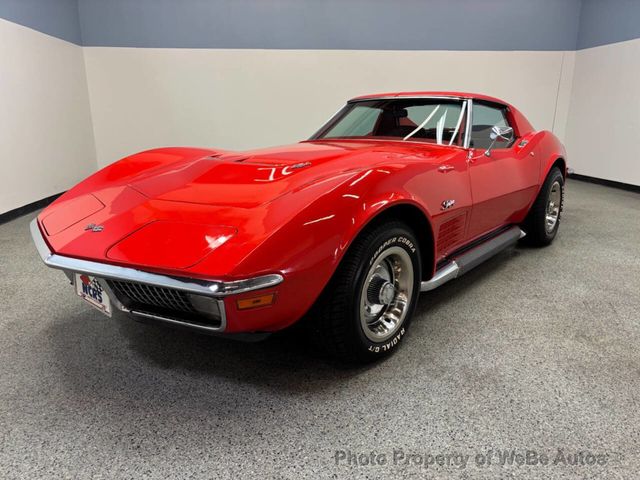
By the time the C3 generation arrived in 1968, the Corvette had accumulated enough cultural weight that filmmakers were using it almost iconically, the way an earlier generation of directors used the Cadillac. The difference was aspiration. A Cadillac in a film said the character had money. A Corvette said the character had ambitions. Those are different statements, and Hollywood understood the distinction.
| Generation | Years | Key cultural moment | Design era |
|---|---|---|---|
| C1 | 1953-1962 | Route 66 TV series (1960-1964) | Chrome-era roadster |
| C2 Sting Ray | 1963-1967 | Split-window coupe becomes design icon | Jet-age styling |
| C3 | 1968-1982 | Peak Hollywood presence, T-top era | Mako Shark influence |
| C4 | 1984-1996 | NASA astronaut program tie-in | Wedge modernism |
| C5 | 1997-2004 | Racing redemption at Le Mans | Contemporary American |
Astronauts and the space age connection
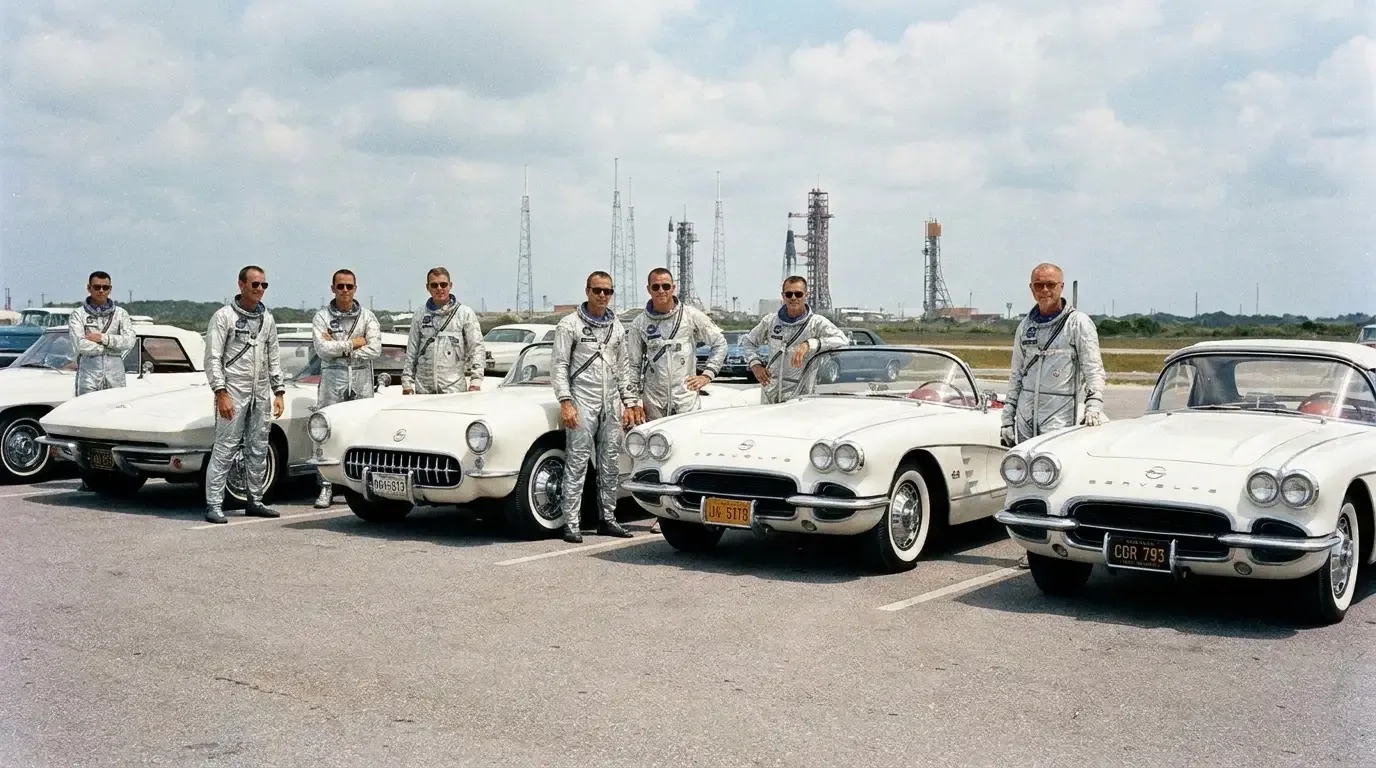
The NASA relationship is one of the stranger chapters in the Corvette story, and also one of the most genuinely earned. It began in the early 1960s when Alan Shepard, the first American in space, received a white 1962 Corvette from GM executive Edward Cole not long after his historic flight. Shepard already drove Corvettes, and the gift was as much a recognition of cultural alignment as a promotional gesture.
What followed was less an official program than a cultural alignment. Jim Rathmann, a racing driver who won the Indianapolis 500 in 1960 and became a Chevrolet dealer in Melbourne, Florida, worked out arrangements through which astronauts could lease Corvettes at one dollar per year. The Mercury and Gemini and Apollo astronauts drove Corvettes to work at a moment when the American public was watching those men as closely as it watched anyone. The cars appeared in photographs and newsreel footage. The association became self-reinforcing.
By the mid-1960s, the connection between the Corvette and the space program had calcified into something like official symbolism. Both were American engineering achievements that looked unlike anything else in the world. Both were sold as expressions of what this country could do when it decided to try. The marketing departments at General Motors understood this perfectly well, and they were not shy about drawing the connection in print ads throughout the decade.
Gus Grissom and John Young were photographed with their Corvettes around the time of their March 1965 Gemini 3 mission, and those images circulated widely. It was not staged, exactly, but it was also not accidental. The astronauts liked the cars. The cars photographed well next to rockets. Everyone understood what the pictures were saying.
"The astronaut connection gave the Corvette something no advertising campaign could manufacture: genuine credibility with the people America was treating as its national heroes. When Shepard drove one to work, it meant something. When the Apollo guys drove them, it still meant something. That is a hard thing to replicate, and General Motors was smart enough to let it breathe rather than over-engineer it."
— Patrick Walsh
The crossed flags and what a logo carries
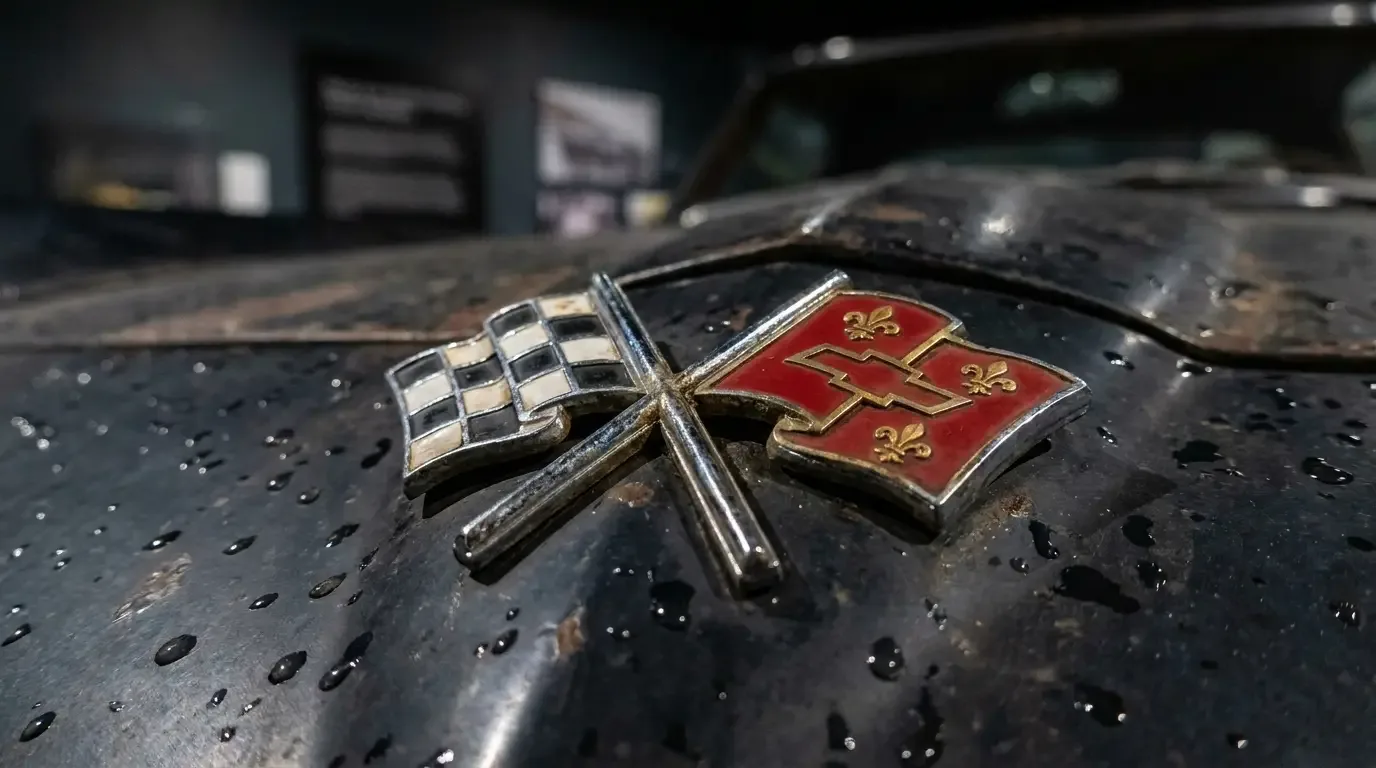
The crossed-flags emblem has been on the Corvette since the beginning. The specific design has shifted across the generations, but the basic idea, two flags crossing at an angle, has been present since the 1953 model. One flag is a checkered racing flag. The other originally showed a fleur-de-lis design alongside the Chevrolet bow-tie symbol, a nod to the French origin of the Chevrolet name, and has evolved through various treatments across the decades. The American flag was considered for the original design but was removed before production because commercial use of the national flag raised legal concerns.
What the emblem communicates is worth thinking about. The checkered flag ties the car to racing directly and immediately. Whoever is driving this car, the badge says, is at minimum adjacent to competition. The flag is not a suggestion. It is a claim. The Corvette earned that claim more thoroughly than most badges manage, through actual race results at Sebring and Le Mans and on American road courses from the 1950s onward.
The logo evolution tracked American design trends in miniature. The 1950s version was elaborate in the chrome-and-enamel tradition of the era. The 1960s versions cleaned up. The 1980s brought a boxier, more angular treatment in line with the C4 design aesthetic. The C5 and C6 versions returned to something more refined. Each iteration preserved the essential crossed-flag structure while updating the surrounding treatment. It is one of the more successful badge evolutions in American automotive history, recognizable at any era while never quite frozen in any one of them.
Music, advertising, and the car as statement
The car showed up in popular music in ways that ranged from direct to oblique. "G.T.O.," the 1964 Ronny and the Daytonas hit (commonly referred to by its opening lyric "Little GTO"), was about a Pontiac, but the broader genre of car songs in early 1960s rock and roll treated the Corvette as a reference point even when it was not the subject. Jan and Dean's "Dead Man's Curve" (released December 1963, charting in 1964) put a Corvette Sting Ray in the narrative not because it was the only fast American car but because it was the one that meant something to the teenage audience the song was targeting.
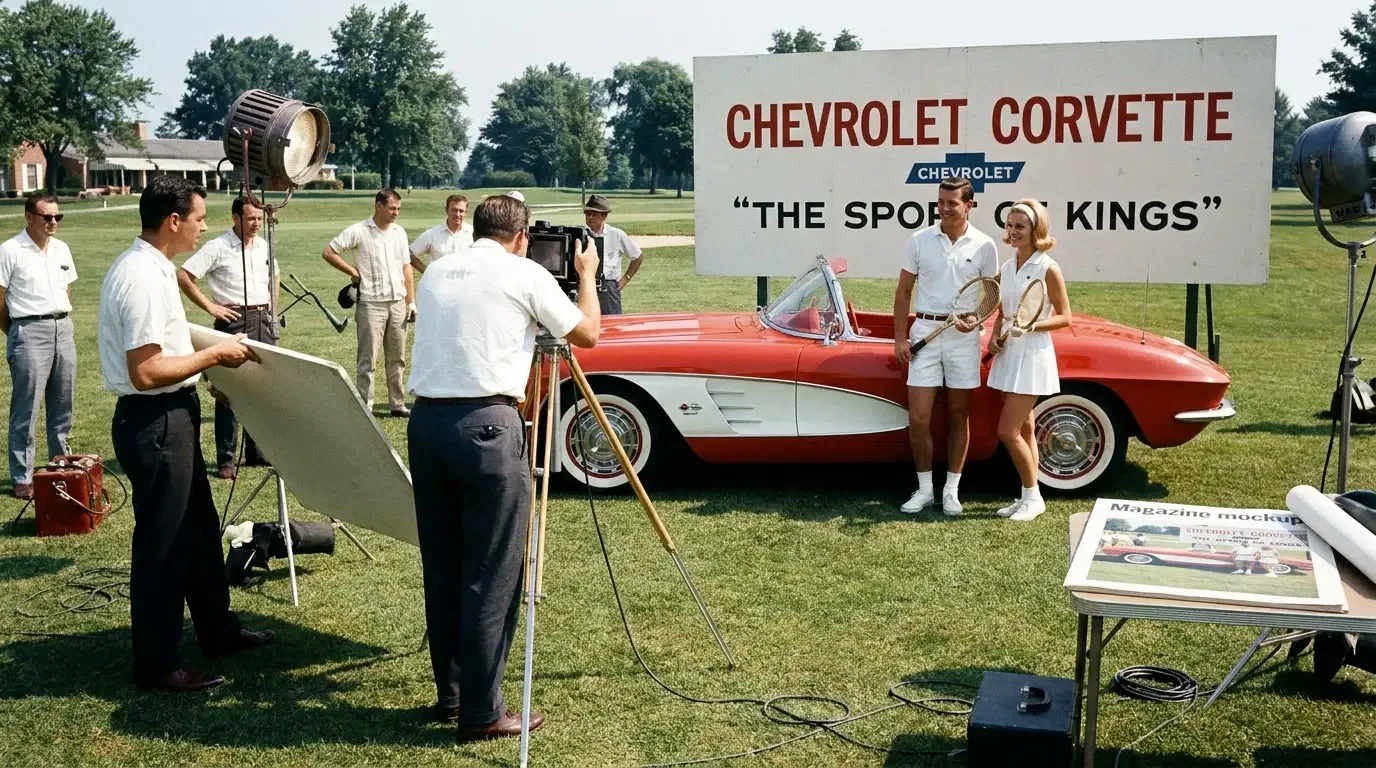
Television advertising from the 1960s and 1970s used the Corvette as a reward, the car shown at the end of a sequence after the protagonist had accomplished something, driven through landscapes designed to suggest freedom and space. The copy from the period is interesting to read now. It leans heavily on the language of achievement: earned, deserved, arrived. The car was positioned as proof of success rather than as a performance machine, which was a conscious choice by Chevrolet's marketing operation and one that fit the broader cultural function the Corvette was performing.
Country music found it later. By the 1980s and 1990s, the Corvette appeared in country songs as a marker of mid-American aspiration, something to be dreamed about and occasionally owned. The class connotations had shifted slightly from the space-age imagery of the 1960s, but the fundamental idea had not: the Corvette was what success looked like when you drove it.
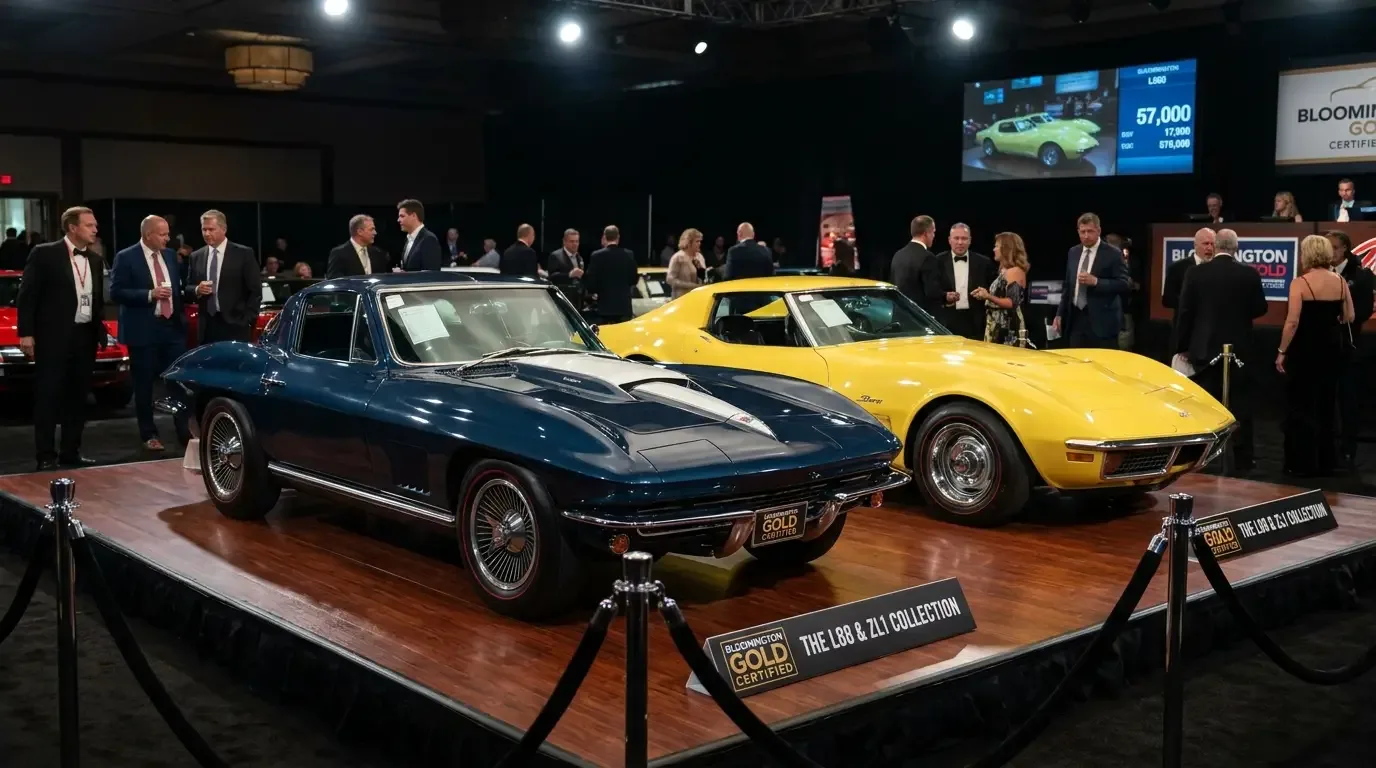
If you want to explore what's available in the collector market today, browsing classic Corvette for sale listings shows just how many of these cultural-touchstone cars are still changing hands, from honest drivers to restored show cars.
What the car became and why it stayed
The Corvette has been in continuous production since 1953, which is an unusual fact to sit with. Most American cars from that era are long gone. The Thunderbird came and went and came back in diluted form. The Camaro and Firebird took a hiatus. The Corvette never stopped. It survived market pressures that killed stronger nameplates, survived executive indifference in some periods, survived the emissions era of the mid-1970s when the performance numbers dropped sharply and the car had to trade on style rather than speed.
The reason it survived is partly that it had accumulated too much cultural weight to kill easily. By the time the C4 arrived in 1984, the Corvette had been in American culture for thirty years. It had appeared in enough films, been driven by enough astronauts, been the subject of enough songs and advertisements and conversations that discontinuing it would have required explaining to the American public why this particular symbol was no longer being produced. General Motors' management understood, even in difficult years, that the Corvette was not just a product. It was a statement about what the company was.
The understanding the birth of the Corvette gives you is essential context here: the car nearly died in its first two years, rescued only by the combination of Zora Arkus-Duntov's engineering interventions and the competitive pressure of the Ford Thunderbird. The fact that it survived that early crisis and then became a cultural institution tells you something about how contingent this whole story was. A different executive decision in 1954 or 1955 and there is no Route 66, no astronaut photographs, no crossed-flags logo that half of America can identify on sight.
The shorthand that stuck
American culture has a relatively small vocabulary of objects that carry consistent meaning across generations. The Corvette is in that vocabulary. Show a split-window 1963 coupe in a film set in the early 1960s and no director needs to explain to the audience what that car means. Show the T-top C3 from the 1970s and the era declares itself. The car works as visual shorthand because enough Americans have cared about it for long enough that the reference reads immediately.
That kind of cultural weight is not manufactured directly. General Motors benefited from the NASA association and used it in advertising, but they did not create it. The TV producers who put the Corvette in Route 66 understood the car's appeal but did not invent it. The musicians who referenced it were borrowing a meaning that was already there. The Corvette became a cultural symbol through accumulation: decision after decision, year after year, from the astronauts who drove them to work to the teenagers who put posters of them on their bedroom walls.
What remains interesting is that the cultural meaning never quite calcified into nostalgia alone. Each new generation of the car extended the story rather than simply commemorating the previous one. The C5-R that won the GTS class at Le Mans in 2001, finishing 1-2 in class in a rain-soaked 24-hour race, was doing something the original 1953 Corvette could not have done, and that performance record fed back into the cultural image rather than contradicting it. The car that stands for American freedom and success has had to earn that position repeatedly, and for most of its history, it has.
Sources and notes
- Wikipedia: Route 66 (TV series) — confirmed CBS run 1960-1964, Tod Stiles and Buz Murdock characters, Corvette as principal vehicle
- Indianapolis Motor Speedway: Jim Rathmann obituary — confirmed 1960 Indy 500 win, Melbourne Florida dealership, astronaut Corvette lease program
- Jalopnik: The AstroVettes — confirmed $1-per-year lease arrangement, astronaut Corvette culture at Cape Canaveral in the 1960s
- Wikipedia: Dead Man's Curve (Jan and Dean) — confirmed December 1963 release date, Corvette Sting Ray featured in song narrative
- 24h-lemans.com: 2001 Le Mans results — confirmed C5-R 1-2 GTS class finish, first official Corvette Racing class win at Le Mans
- Capitol City Corvette Club: History of the Corvette Emblem — confirmed fleur-de-lis origin, American flag removal, crossed-flags continuity since 1953